
When Residential HVAC Isn’t Enough
Large single-family homes, multi-unit residential buildings, and mixed-use properties frequently outgrow standard residential HVAC equipment. Square footage above 3,500 feet, multiple zones, high ceilings, large glass exposure, and properties combining living and commercial space all place demands that consumer-grade split systems were never engineered to handle. This is where commercial-grade HVAC systems enter the picture — equipment originally designed for offices, retail spaces, and light-industrial buildings, now increasingly specified for high-end residential and mixed-use construction because of superior durability, tighter zoning control, and lower long-term operating costs per square foot.
Advertisement
This guide breaks down when a commercial-grade system makes sense, how the equipment differs from residential units, what it costs installed, and how to evaluate contractors qualified to install and service this class of equipment.
Residential vs. Commercial-Grade HVAC: What Actually Differs
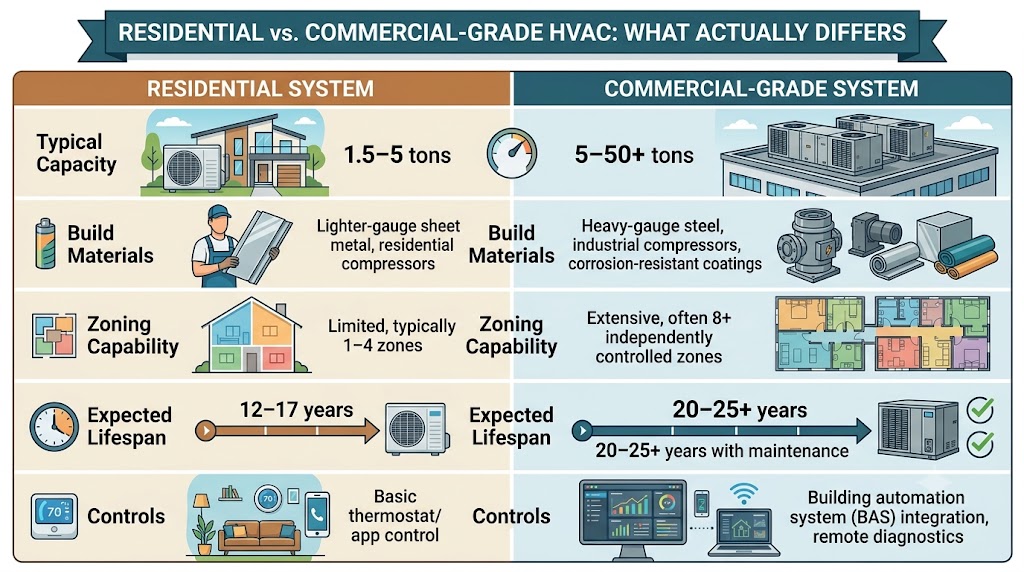
| Feature | Residential System | Commercial-Grade System |
|---|---|---|
| Typical Capacity | 1.5–5 tons | 5–50+ tons |
| Build Materials | Lighter-gauge sheet metal, residential compressors | Heavy-gauge steel, industrial compressors, corrosion-resistant coatings |
| Zoning Capability | Limited, typically 1–4 zones | Extensive, often 8+ independently controlled zones |
| Expected Lifespan | 12–17 years | 20–25+ years with maintenance |
| Controls | Basic thermostat/app control | Building automation system (BAS) integration, remote diagnostics |
Types of Commercial HVAC Equipment Used in Large Residential Properties
- Rooftop Units (RTUs): Packaged systems installed on flat or low-slope roofs, common in large custom homes and multi-family buildings.
- Variable Refrigerant Flow (VRF) Systems: Highly efficient, allow simultaneous heating and cooling across different zones of a large property.
- Chiller Systems: Used in very large estates or mixed-use buildings requiring centralized cooling distribution.
- Geothermal Commercial Heat Pumps: Increasingly specified for high-efficiency large-home construction due to long-term energy savings and available federal tax incentives.
Installed Cost Breakdown
Commercial-grade HVAC installation costs vary enormously based on property size, system type, and ductwork condition. As a planning baseline:
- VRF systems: $18,000–$45 per ton installed for large residential applications, often $60,000–$150,000 total for large estates.
- Rooftop packaged units: $12,000–$35,000 per unit depending on tonnage and roof access.
- Chiller-based systems: $80,000–$250,000+, generally reserved for very large or multi-building properties.
- Ductwork modification or replacement: $8–$18 per linear foot, a major cost driver on retrofit projects.
Energy Efficiency and Long-Term Operating Costs
Commercial-grade systems are rated using SEER2, EER2, and IEER metrics rather than the simplified SEER ratings used for consumer units. Higher-efficiency VRF and geothermal systems can reduce annual energy costs by 30–45% compared to aging residential-grade equipment, which matters significantly on large properties where HVAC can represent the single largest utility expense. Property owners should request a full energy modeling report from their contractor before selecting equipment, particularly for new construction or major renovations where system sizing decisions are difficult to reverse later.
How to Choose a Commercial HVAC Contractor for a Residential Project
Not every HVAC contractor is qualified to design and install commercial-grade systems in a residential context. Use this checklist when vetting contractors:
- Does the company hold a commercial mechanical contractor license in your state, not just a residential HVAC license?
- Can they provide a Manual J/Manual D load calculation and duct design specific to commercial-grade equipment?
- Do they have documented experience installing VRF or chiller systems in residential or mixed-use settings?
- What preventive maintenance contract options do they offer, and do they include quarterly filter, coil, and refrigerant checks?
- Are they authorized dealers for major commercial brands, which typically extends manufacturer warranty coverage?
Maintenance Requirements for Commercial-Grade Systems
Commercial equipment demands more disciplined maintenance scheduling than residential units, typically quarterly rather than annual service. A comprehensive maintenance contract should include coil cleaning, refrigerant charge verification, belt and bearing inspection, controls calibration, and filter replacement. Annual maintenance contracts for large commercial-grade residential systems typically range from $1,500–$6,000 depending on system complexity and number of units, but this investment is significantly cheaper than emergency repairs or premature compressor failure.
Financing, Rebates, and Tax Incentives
High-efficiency commercial HVAC installations, particularly geothermal and VRF systems, may qualify for federal energy efficiency tax credits as well as state and utility rebate programs. Property owners should request documentation of applicable incentive programs from their contractor before finalizing a system selection, as this can materially reduce total project cost. Many commercial HVAC suppliers also offer equipment financing or lease-to-own programs for large installations.
Common Mistakes Property Owners Make When Upgrading to Commercial-Grade HVAC
The most frequent and costly mistake is hiring a residential-only HVAC contractor to install commercial-grade equipment simply because they offered the lowest bid. Commercial systems require different design calculations, refrigerant piping practices, and controls programming than residential-grade equipment, and a contractor without documented commercial experience is far more likely to make sizing or installation errors that surface as comfort complaints, high energy bills, or premature equipment failure. A second common error is skipping a proper load calculation and instead sizing equipment based on rules of thumb or the capacity of the system being replaced, which may itself have been incorrectly sized originally. Property owners should also avoid selecting equipment based solely on upfront cost without evaluating total cost of ownership — a less efficient system can cost significantly more over a 20-year lifespan through higher utility bills, even if the initial purchase price is lower. Finally, neglecting to budget for controls integration and commissioning, which ensures the system actually operates as designed once installed, frequently leads to systems that technically function but never achieve their designed efficiency or comfort performance.
Regional Climate and Building Code Considerations
Commercial-grade HVAC specification varies considerably by climate zone. In hot-humid regions such as the Gulf Coast and Southeast, dehumidification capacity becomes as important as raw cooling tonnage, and oversized equipment can actually worsen humidity control by short-cycling before adequately removing moisture from the air. In cold northern climates, commercial-grade heat pump systems increasingly compete with traditional gas furnace and boiler systems, particularly as cold-climate heat pump technology has improved significantly in recent years, though backup heat strips or a dual-fuel configuration are often still recommended for extreme cold snaps. Many states have also adopted increasingly stringent energy codes that apply additional requirements to larger residential and mixed-use HVAC installations, including mandatory economizer controls, enhanced duct sealing verification, and minimum efficiency thresholds that exceed the baseline federal minimums — a qualified commercial contractor should be familiar with your specific state’s current code requirements.
Building Automation System (BAS) Integration for Large Properties
One of the most significant advantages commercial-grade HVAC systems offer over residential equipment is integration with a building automation system, which allows centralized monitoring and control of temperature, humidity, and equipment status across an entire property from a single interface. For large estates, multi-building properties, or mixed residential-commercial developments, a BAS can automatically optimize equipment scheduling based on occupancy patterns, weather forecasts, and utility rate structures, often delivering additional energy savings beyond what the equipment’s inherent efficiency provides. BAS integration does add upfront cost and typically requires a specialized controls contractor in addition to the mechanical installer, but for larger properties this investment frequently pays for itself through reduced energy waste and simplified facilities management.
Reading a Commercial HVAC Proposal Like a Professional
A trustworthy commercial HVAC proposal should reference specific Manual J load calculation results rather than a rule-of-thumb square-footage estimate, since accurate load calculation is the foundation of correct equipment sizing and long-term comfort and efficiency performance. The proposal should specify exact equipment model numbers, their SEER2/EER2/IEER efficiency ratings, and sound ratings (particularly important for VRF outdoor units placed near living spaces or neighboring properties). For multi-zone systems, confirm the proposal includes a zoning diagram showing which areas are served by each zone and how controls will be configured. Finally, request clarity on commissioning — the process of verifying the installed system actually performs to its designed specifications — since a system that is installed correctly but never properly commissioned frequently underperforms its theoretical efficiency and comfort potential.
Making the Final Decision: Total Cost of Ownership
When comparing commercial-grade HVAC options against standard residential-grade replacements, it’s worth building a simple total cost of ownership comparison spanning at least 15-20 years, rather than focusing solely on the upfront installation quote. This comparison should account for the higher upfront cost of commercial-grade equipment, offset against lower expected energy bills, fewer anticipated replacement cycles given the longer rated lifespan, and the value of more granular zoning control if comfort complaints have been a persistent issue with your current system. For many owners of larger homes, particularly those planning to remain in the property long-term, this full comparison makes the case for commercial-grade equipment considerably more compelling than the upfront price difference alone might suggest, even though it requires a larger initial investment than a comparable residential-grade replacement.
Working With Architects and Builders on New Construction
For homeowners planning new construction or a major addition, involving a commercial HVAC contractor early in the design process — ideally alongside the architect — allows equipment placement, ductwork routing, and structural provisions for larger commercial-grade equipment to be integrated into the building design from the outset, rather than retrofitted afterward. This collaborative approach frequently results in better system performance, more discreet equipment placement, and lower overall installation cost compared to specifying HVAC equipment only after the building’s structural and architectural plans are already finalized.
Key Terms Glossary
- SEER2/EER2/IEER: Updated efficiency rating standards used for commercial-grade HVAC equipment, measuring cooling output relative to energy consumed under standardized test conditions.
- VRF (Variable Refrigerant Flow): A system technology allowing simultaneous heating and cooling across different zones by precisely modulating refrigerant flow to each indoor unit.
- Manual J Calculation: The industry-standard method for calculating a building’s heating and cooling load, used to correctly size HVAC equipment.
- Building Automation System (BAS): A centralized control platform integrating HVAC, lighting, and other building systems for coordinated, often automated, operation.
- Commissioning: The formal process of testing and verifying that installed HVAC equipment performs according to its designed specifications before final project sign-off.
Frequently Asked Questions
At what home size does commercial-grade HVAC make sense?
Most contractors begin recommending commercial-grade equipment or hybrid commercial/residential systems around 4,000–5,000 square feet, or for any property with complex zoning needs, high ceilings, or significant glass exposure.
Is commercial-grade HVAC more expensive to install than residential equipment?
Yes, upfront costs are typically 30–60% higher, but the equipment generally lasts longer, requires fewer replacements, and can lower long-term operating costs through superior efficiency and zoning control.
Can commercial HVAC systems be integrated with smart home technology?
Modern commercial-grade systems increasingly support building automation system integration, which can be bridged with smart home platforms through specialized gateways, though this typically requires a specialized integrator.
How often should a commercial-grade residential HVAC system be serviced?
Quarterly maintenance is the industry standard recommendation for commercial-grade equipment, compared to the twice-yearly schedule typical for residential systems.
Do commercial HVAC systems require special permitting?
Yes, commercial-grade installations typically require mechanical permits reviewed under commercial building code provisions, even when installed in a residential setting, and should always be handled by a licensed commercial contractor.
How much can I expect to save on energy bills after upgrading?
Homeowners replacing aging, inefficient residential equipment with a properly sized commercial-grade VRF or geothermal system commonly report 25-40% reductions in HVAC-related energy costs, though actual savings depend heavily on the condition of the prior system, climate zone, and building envelope efficiency.
What is the typical lifespan difference and does it justify the extra upfront cost?
Commercial-grade equipment is generally engineered for 20-25+ years of service compared to 12-17 years for residential-grade units, meaning a property owner may avoid an entire additional replacement cycle over a typical ownership period, which for many buyers offsets much of the higher initial investment.
Request Quotes From Licensed Commercial HVAC Contractors
Given the scale of investment involved, property owners should obtain at least three detailed proposals from licensed commercial HVAC contractors before committing to a system. Compare not just equipment cost, but warranty terms, maintenance contract pricing, and documented experience with similar large-property installations. This article may contain affiliate links to vetted HVAC contractor-matching services; we may earn a commission if you request a quote through these links, at no additional cost to you.
Advertisement