
Why Residential Fire Suppression Is Gaining Attention
Fire suppression technology has traditionally been associated with commercial buildings, but rising wildfire risk in many U.S. regions, growing awareness of home fire statistics, and increasing availability of residential-scale sprinkler and suppression systems have made this category increasingly relevant for homeowners — particularly those building custom homes, living in wildfire-prone areas, or managing larger properties with detached structures like garages, workshops, or barns.
Advertisement
Types of Residential Fire Protection Systems
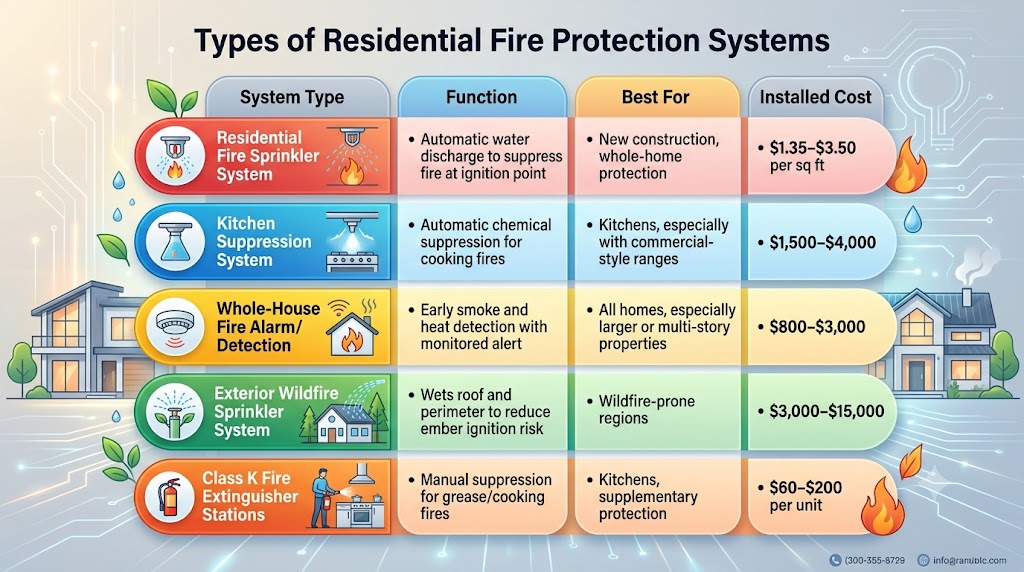
| System Type | Function | Best For | Installed Cost |
|---|---|---|---|
| Residential Fire Sprinkler System | Automatic water discharge to suppress fire at ignition point | New construction, whole-home protection | $1.35–$3.50 per sq ft |
| Kitchen Suppression System | Automatic chemical suppression for cooking fires | Kitchens, especially with commercial-style ranges | $1,500–$4,000 |
| Whole-House Fire Alarm/Detection | Early smoke and heat detection with monitored alert | All homes, especially larger or multi-story properties | $800–$3,000 |
| Exterior Wildfire Sprinkler System | Wets roof and perimeter to reduce ember ignition risk | Wildfire-prone regions | $3,000–$15,000 |
| Class K Fire Extinguisher Stations | Manual suppression for grease/cooking fires | Kitchens, supplementary protection | $60–$200 per unit |
Residential Fire Sprinklers: How They Actually Work
Contrary to a common misconception reinforced by Hollywood depictions, residential fire sprinklers activate individually, only in the specific room where heat reaches the activation threshold (typically around 155°F) — not throughout the entire house simultaneously. A single sprinkler head can control or extinguish most residential fires long before fire department arrival, using a fraction of the water damage caused by manual firefighting efforts. NFPA data has consistently shown that homes with sprinkler systems experience significantly reduced fire deaths and property loss compared to homes without them.
Wildfire-Specific Protection Systems
For properties in wildfire-prone regions, exterior sprinkler and ember-defense systems represent a growing category of investment. These systems typically include roof-mounted sprinklers, perimeter misting nozzles, and sometimes gutter-mounted protection, all designed to saturate the structure and surrounding vegetation ahead of an approaching fire front, reducing ember ignition risk. Some systems integrate with weather and fire-tracking alerts to activate automatically or remotely. Insurance carriers in high-risk wildfire zones increasingly offer premium discounts or, in some cases, require documented mitigation measures including these systems to maintain coverage.
Kitchen Fire Suppression: An Overlooked Investment
Cooking equipment remains the leading cause of home structure fires. Homeowners with commercial-style ranges, indoor griddles, or extensive cooking setups increasingly install automatic kitchen suppression systems similar to those required in commercial kitchens — a wet chemical system that automatically discharges over the cooking surface when triggered by heat, cutting gas supply simultaneously. This category has grown alongside the trend of professional-grade kitchen equipment in high-end residential construction.
New Construction vs. Retrofit Considerations
Installing fire sprinklers during new construction is significantly more cost-effective than retrofitting an existing home, since piping can be integrated into the framing before drywall installation. Retrofit projects require more invasive work to route piping through existing walls and ceilings, typically increasing cost by 30–60% compared to new construction pricing. Homeowners planning a major renovation should strongly consider incorporating fire sprinkler infrastructure at that time, even if not otherwise required by local code.
Building Codes and Local Requirements
Residential fire sprinkler requirements vary significantly by state and municipality — some jurisdictions mandate sprinklers in new single-family construction, while others leave it optional. Homeowners should check with their local building department early in the planning process, as code requirements affect both design and budget. Even where not required, many fire protection engineers and insurance professionals recommend voluntary installation given the substantial safety and property protection benefits.
How to Choose a Fire Protection Contractor
- Is the contractor licensed specifically for fire protection/sprinkler system installation in your state (this typically requires separate licensing from general plumbing)?
- Do they design to NFPA 13D standards, the specific standard for one- and two-family residential sprinkler systems?
- For kitchen suppression, are they certified to service and inspect UL 300-compliant systems?
- Do they provide required annual inspection and certification services after installation?
- Can they coordinate with your local fire marshal’s office for required permitting and inspection?
Insurance and Long-Term Value
Many homeowners insurance carriers offer premium discounts for documented fire sprinkler systems and monitored fire alarm systems, and in wildfire-prone regions, mitigation measures increasingly affect insurability itself as carriers reassess risk in high-exposure areas. Beyond insurance considerations, professionally installed fire suppression infrastructure is increasingly viewed as a valuable feature in luxury and custom home real estate listings, particularly in regions where wildfire risk has become a significant buyer concern.
Common Mistakes Homeowners Make Regarding Fire Protection
A common and understandable misconception is assuming smoke detectors alone provide adequate protection; while smoke detectors are an essential and legally required baseline, they only alert occupants to a fire already in progress and provide no active suppression, meaning a fire can grow significantly, particularly when no one is home, before any response occurs. Another frequent mistake is delaying fire sprinkler consideration until a major renovation is already underway rather than the early planning stage, since retrofit costs are substantially higher once framing and drywall decisions have already been finalized. Homeowners installing high-end kitchen equipment, including commercial-style ranges with high BTU output, sometimes overlook that this equipment category carries meaningfully elevated fire risk compared to standard residential ranges, making dedicated kitchen suppression a more relevant consideration than for a standard kitchen setup. Finally, neglecting the annual inspection requirements for installed fire protection systems, where applicable, can result in a system that appears functional but has a maintenance issue that would prevent proper activation during an actual fire event.
Regional Wildfire Risk and Home Hardening
Wildfire risk has expanded significantly beyond traditionally recognized high-risk zones in recent years, with many previously lower-risk areas in the western and southwestern United States now facing elevated exposure due to changing climate and vegetation patterns. Comprehensive wildfire protection extends beyond exterior sprinkler systems to include broader home-hardening measures: ember-resistant vents, non-combustible roofing and siding materials, and defensible space landscaping that maintains adequate vegetation clearance around the structure. Many state and local governments now offer wildfire mitigation grant or rebate programs to offset the cost of these improvements, and some insurance carriers in high-risk zones have begun requiring documented mitigation measures as a condition of maintaining or renewing coverage, making this an increasingly important consideration beyond pure safety benefit.
Understanding NFPA 13D Design Requirements
NFPA 13D is the specific national standard governing sprinkler systems in one- and two-family residential occupancies, distinct from the more stringent NFPA 13 standard used in commercial buildings. This residential-specific standard is designed to provide life-safety protection — allowing occupants time to escape — rather than the full property protection standard required in commercial applications, which is reflected in a somewhat simpler and more cost-effective design approach appropriate for residential use. Understanding this distinction helps homeowners have informed conversations with fire protection contractors and avoid either under-speccing a system that doesn’t meet code, or over-speccing an unnecessarily costly commercial-grade design when a properly engineered NFPA 13D system provides appropriate protection for a residential application.
Reading a Fire Protection Proposal Like a Professional
A trustworthy fire sprinkler proposal should reference specific NFPA 13D design compliance and include a sprinkler head layout diagram showing coverage across affected rooms, rather than a vague total price for “whole-home sprinklers.” Confirm the proposal specifies pipe material (typically CPVC or steel), water supply source and calculated pressure requirements, and whether a dedicated fire pump is needed to meet code-required pressure at the most remote sprinkler head. For kitchen suppression systems, request confirmation of UL 300 compliance, which is the current standard governing wet chemical kitchen suppression systems. Finally, clarify what ongoing inspection and testing is included in the proposal versus billed separately in future years, since most jurisdictions require periodic professional inspection to maintain code compliance and system reliability over time.
Making the Final Decision: Layered Protection
The most effective residential fire protection strategy generally combines multiple layers rather than relying on a single system — properly maintained smoke detectors for early warning, sprinklers or kitchen suppression for active fire control, and where relevant, exterior wildfire mitigation measures for regional risk factors. Homeowners evaluating where to prioritize limited budget should generally start with any code-required baseline protection, then layer in additional systems based on their property’s specific risk profile: kitchen suppression for households with high-output cooking equipment, wildfire sprinklers for properties in high-risk zones, and comprehensive interior sprinklers for new construction or major renovation projects where installation cost is most favorable.
Coordinating Fire Protection With Insurance and Resale
Documented fire suppression systems can meaningfully affect both insurability and premium pricing, particularly in wildfire-prone regions where some carriers have begun requiring mitigation measures as a condition of coverage. Beyond insurance, buyers in fire-risk-conscious markets increasingly view documented fire protection systems as a meaningful selling point, making this an investment that can pay dividends both in reduced risk and in future resale positioning, particularly for properties in regions where wildfire risk has become a prominent buyer consideration. Retaining documentation of system design, code compliance certification, and maintenance history in an accessible file also simplifies future inspections, insurance renewals, and eventual resale disclosures, and represents good practice for any significant life-safety system investment in the home.
Key Terms Glossary
- NFPA 13D: The national fire protection standard specifically governing sprinkler systems in one- and two-family residential occupancies.
- UL 300: The current standard governing wet chemical kitchen fire suppression systems.
- Ember Ignition: The process by which windborne embers from a wildfire ignite a structure, often the primary risk mechanism exterior wildfire sprinkler systems are designed to mitigate.
- Class K Extinguisher: A fire extinguisher specifically rated for cooking oil and grease fires, distinct from standard household extinguisher classes.
Frequently Asked Questions
Do residential fire sprinklers cause more water damage than the fire itself?
No — because only the sprinkler head nearest the fire activates, water damage from a sprinkler-controlled fire is typically far less than damage from a fire that spreads uncontrolled or from firefighting hose lines used to extinguish a larger blaze. This is a common misconception worth correcting, since it’s frequently cited as a reason homeowners hesitate to install sprinkler systems despite the strong safety data supporting them.
Are fire sprinkler systems required by law?
Requirements vary by state and municipality; some require sprinklers in new single-family construction while others do not. Check with your local building department for current requirements in your area.
How much maintenance do residential fire sprinkler systems require?
Systems generally require minimal maintenance beyond periodic visual inspection and occasional professional testing, typically far less involved than commercial systems, though local code may specify a required inspection interval.
Can fire sprinklers be added to an existing finished home?
Yes, though retrofit installation is more labor-intensive and costly than new construction due to the need to route piping through existing walls and ceilings.
What is the difference between a smoke detector and a fire suppression system?
Smoke detectors only alert occupants to a fire; suppression systems actively work to control or extinguish the fire itself, providing protection even when occupants aren’t present to respond.
Do wildfire sprinkler systems require an independent water supply?
Many exterior wildfire protection systems are designed to draw from a dedicated water storage tank or pool rather than relying solely on municipal or well supply, since municipal water pressure and availability can be compromised during a large-scale wildfire event; system design should account for this contingency.
Are fire suppression systems required for commercial-style kitchen equipment in a home?
Requirements vary by jurisdiction and aren’t universally mandated for residential kitchens even with commercial-style equipment, though many fire protection professionals recommend it given the elevated fire risk profile of high-BTU cooking equipment; check with your local fire marshal for specific requirements in your area.
Get a Fire Protection Assessment for Your Property
Whether you’re building new construction, renovating, or evaluating wildfire mitigation options, a licensed fire protection contractor can assess your property’s specific risk factors and recommend appropriate systems. Request quotes from multiple NFPA 13D-certified installers to compare design approaches and pricing. This article may contain affiliate links to vetted fire protection contractor-matching services; we may earn a commission if you request a quote through these links, at no additional cost to you.
Advertisement