
Why Homeowners Are Upgrading to Commercial-Grade Filtration
Municipal water quality varies enormously across the United States, and concerns about contaminants ranging from PFAS “forever chemicals” to lead, chlorine byproducts, hard water minerals, and agricultural runoff have driven growing demand for whole-house filtration systems that go beyond a simple under-sink pitcher filter. Commercial-grade filtration equipment — originally designed for restaurants, medical facilities, and industrial applications — is increasingly specified for residential whole-house systems because of its higher flow capacity, longer filter life, and more rigorous contaminant reduction certifications.
Advertisement
Types of Whole-House Filtration Systems
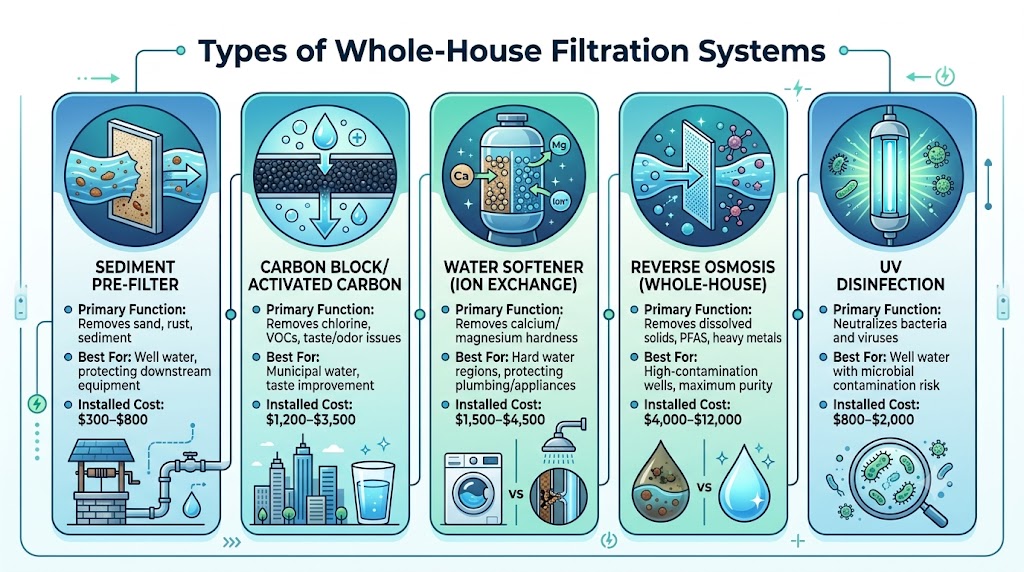
| System Type | Primary Function | Best For | Installed Cost |
|---|---|---|---|
| Sediment Pre-Filter | Removes sand, rust, sediment | Well water, protecting downstream equipment | $300–$800 |
| Carbon Block/Activated Carbon | Removes chlorine, VOCs, taste/odor issues | Municipal water, taste improvement | $1,200–$3,500 |
| Water Softener (Ion Exchange) | Removes calcium/magnesium hardness | Hard water regions, protecting plumbing/appliances | $1,500–$4,500 |
| Reverse Osmosis (Whole-House) | Removes dissolved solids, PFAS, heavy metals | High-contamination wells, maximum purity | $4,000–$12,000 |
| UV Disinfection | Neutralizes bacteria and viruses | Well water with microbial contamination risk | $800–$2,000 |
Understanding Your Water: The Necessary First Step
Before selecting any filtration system, homeowners should obtain a certified water test — either through the local municipal water quality report (for city water) or an independent laboratory test (essential for well water, which isn’t regulated or tested by any government agency). A proper water test identifies specific contaminants present, their concentration, and water hardness, which determines the correct filtration technology needed. Selecting a system without this data often results in an expensive mismatch between the equipment and the actual water quality issue.
Commercial-Grade vs. Consumer-Grade Filtration Equipment
- Flow capacity: Commercial-grade systems handle significantly higher gallons-per-minute flow rates, preventing water pressure drops in larger homes with multiple simultaneous water uses.
- Filter media volume: Larger filter tanks mean longer intervals between filter changes and more consistent contaminant reduction over the filter’s life.
- Certification standards: Look for NSF/ANSI certification (NSF/ANSI 42, 53, 58, and 401 cover different contaminant categories), which independently verifies a system’s actual contaminant reduction claims.
- Build materials: Commercial-grade systems typically use more durable tank and valve materials rated for continuous, higher-volume operation.
Addressing Specific Contaminants
- PFAS (“forever chemicals”): Requires reverse osmosis or specialized ion exchange/activated carbon systems certified specifically for PFAS reduction (NSF/ANSI 53 or 58).
- Lead: Reverse osmosis or NSF/ANSI 53-certified filtration is required; standard carbon filters alone are generally insufficient for lead removal.
- Hard water (calcium/magnesium): Traditional salt-based ion exchange softeners remain the most effective solution, though salt-free conditioners are available for households wanting to avoid sodium addition.
- Bacteria/microbial contamination (common in well water): UV disinfection systems are the standard solution, often paired with sediment pre-filtration.
Installation and Maintenance Considerations
Whole-house systems are typically installed at the main water line entry point, requiring plumbing modifications best handled by a licensed plumber or water treatment specialist. Ongoing maintenance varies by system type: carbon filters typically require replacement every 6–12 months, softener resin beds need periodic salt replenishment and eventual resin replacement (5–10 years), and reverse osmosis membranes typically last 2–3 years. Budgeting for ongoing filter and media replacement costs — often $200–$600 annually depending on system complexity — is an important part of total cost of ownership planning.
How to Choose a Water Treatment Specialist
- Do they perform independent water testing rather than relying solely on a sales-oriented “free test” that pushes a specific product?
- Is the equipment NSF/ANSI certified for the specific contaminants identified in your water test?
- Are they a certified Water Quality Association (WQA) professional?
- Do they provide sizing calculations based on your household’s actual water usage and peak flow demand?
- What is the warranty on tanks, valves, and membranes, and is local service available for future maintenance?
Common Mistakes Homeowners Make When Choosing a Filtration System
The most fundamental mistake is purchasing a filtration system before obtaining a certified water test, essentially guessing at a solution rather than matching the technology to actual documented contaminants. This frequently leads to homeowners investing in expensive reverse osmosis systems when a simpler carbon filtration system would have adequately addressed their specific water quality issue, or conversely, installing an inadequate carbon-only system when their water contains contaminants that require reverse osmosis for effective reduction. Another common error is neglecting the ongoing cost of filter and media replacement when comparing system options; a lower-upfront-cost system with expensive, frequently replaced proprietary filter cartridges can cost more over five years than a higher-upfront-cost system with less frequent, less expensive standard filter replacement. Homeowners should also avoid installers who push a specific branded product without first presenting independent water test results, since this sales approach often prioritizes a preferred product line over the solution best matched to the home’s actual water chemistry.
Regional Water Quality Considerations
Water quality concerns vary considerably by region and water source. Homes relying on private wells, common throughout rural America, face water quality risks that aren’t monitored or regulated by any government agency, making independent annual testing particularly important for well-owning households, especially for bacterial contamination, nitrates from agricultural runoff, and naturally occurring minerals like iron and manganese that affect taste and plumbing longevity. Regions with older municipal infrastructure, particularly in parts of the Midwest and Northeast, face elevated risk of lead contamination from aging service lines, making point-of-use or whole-house lead-certified filtration a meaningful consideration even when the municipal water leaving the treatment plant meets regulatory standards. Areas near industrial or agricultural activity have increasingly reported PFAS contamination in both municipal and well water supplies, a contaminant class that has drawn significant regulatory attention in recent years and specifically requires PFAS-certified filtration technology for effective reduction.
Understanding Water Hardness and Its Long-Term Impact
Water hardness, caused by dissolved calcium and magnesium, doesn’t pose a direct health risk but can meaningfully affect plumbing longevity, appliance efficiency, and daily household experience. Hard water gradually builds mineral scale inside pipes, water heaters, and appliances, reducing their operational efficiency and lifespan over time, while also affecting soap and detergent performance, often requiring more product to achieve the same cleaning result. Water hardness is measured in grains per gallon (GPG), with anything above 7 GPG generally considered hard water warranting a softening system; homeowners can determine their local water hardness through their municipal water quality report or an independent water test, which should always be part of the evaluation process before selecting a softening or conditioning system.
Reading a Water Treatment Proposal Like a Professional
A trustworthy water treatment proposal should reference your specific water test results directly, explaining which contaminants the proposed system addresses and citing the relevant NSF/ANSI certification standard for each claim, rather than making generic purity claims. Confirm the proposal specifies tank size, flow rate (gallons per minute) at your household’s peak demand, and expected filter or media replacement intervals with associated ongoing costs, since these operational details significantly affect long-term satisfaction and total cost of ownership. For softeners, request the specific grain capacity relative to your documented water hardness and household size, since undersized softeners are a common cause of disappointing performance. Finally, ask whether the installer provides post-installation water testing to confirm the system is performing as designed, which provides objective verification beyond simply trusting that installation alone guarantees proper function.
Making the Final Decision: Start With Data, Not Products
The single most valuable habit homeowners can adopt when navigating water filtration decisions is treating the water test as the foundation of the entire decision-making process, rather than starting with a product and working backward to justify it. A certified water test typically costs a small fraction of the eventual filtration system investment, yet it’s the single factor most likely to determine whether that investment actually solves the household’s real water quality concerns. Homeowners who lead with data — requesting multiple contractor proposals that explicitly reference their specific test results — are consistently better positioned to make a confident, well-justified filtration decision than those who select a system based on general reputation or marketing claims alone.
Coordinating Filtration Upgrades With Real Estate and Well Inspections
For homes on private well water, many mortgage lenders require a water quality test as part of the closing process, making this an opportune time to evaluate whether a filtration system upgrade is warranted before or shortly after purchase. Buyers of well-water properties should request the most recent water test results during due diligence and budget accordingly if results indicate a need for filtration beyond what’s currently installed, since this is a common and sometimes underestimated cost for first-time well-water homeowners transitioning from municipal water service. Sellers of well-water properties can similarly benefit from proactively testing and documenting water quality before listing, since favorable, professionally documented results can serve as a meaningful point of buyer reassurance during negotiations, particularly in regions where well water quality is a common buyer concern during due diligence.
Key Terms Glossary
- NSF/ANSI Certification: Independent third-party certification standards (42, 53, 58, 401) verifying a filtration product’s actual contaminant reduction performance.
- PFAS: Per- and polyfluoroalkyl substances, a class of persistent synthetic chemicals sometimes called “forever chemicals,” requiring specialized filtration for effective removal.
- Reverse Osmosis (RO): A filtration process forcing water through a semi-permeable membrane to remove dissolved solids, heavy metals, and many other contaminants.
- Grains Per Gallon (GPG): The standard unit measuring water hardness, used to determine appropriate water softener sizing.
- WQA: The Water Quality Association, a certifying body for water treatment professionals and products.
Frequently Asked Questions
Do I need a whole-house system if I already have an under-sink filter?
Under-sink filters only treat water at a single point, leaving bathing, laundry, and other household water uses untreated. Whole-house systems address contaminants at every tap, which matters for concerns like chlorine skin/respiratory exposure during showering. Many households ultimately choose a combined approach, using a whole-house system for general contaminant reduction alongside a dedicated under-sink reverse osmosis unit for drinking and cooking water where the highest purity level is desired, giving them both comprehensive whole-home protection and maximum purity where it matters most for consumption, a combination that many water treatment professionals consider the most practical long-term configuration for most households.
Is reverse osmosis necessary for municipal (city) water?
It depends on your specific water quality report. Many municipal systems have low enough contaminant levels that carbon filtration is sufficient, though reverse osmosis provides the most comprehensive protection, particularly for PFAS and heavy metals.
How much does a whole-house system increase home value?
While difficult to quantify precisely, a well-documented, professionally installed filtration system is generally viewed favorably by buyers, particularly in regions with known water quality concerns or private well sources.
What does NSF/ANSI certification actually verify?
These certifications independently test and verify that a filtration product actually reduces the specific contaminants it claims to address, by the percentage claimed, rather than relying on unverified manufacturer marketing claims.
How often should well water be retested after installing a filtration system?
Annual retesting is generally recommended for well water systems to confirm continued effectiveness and catch any changes in source water quality over time.
Does a water softener remove contaminants like lead or bacteria?
No, water softeners are specifically designed to address hardness minerals (calcium and magnesium) and are not effective against contaminants like lead, bacteria, or PFAS, which require different filtration technologies such as reverse osmosis, certified carbon filtration, or UV disinfection.
What maintenance does a whole-house filtration system require?
Maintenance requirements vary by system type but generally include periodic filter cartridge replacement, salt replenishment for softeners, and occasional professional inspection of valves and tanks; most reputable installers provide a specific maintenance schedule tailored to the installed system.
Get a Water Quality Assessment and Custom Quote
Because filtration needs vary enormously based on your specific water source and contaminant profile, the right first step is always a certified water test rather than selecting equipment based on general assumptions. Request assessments and quotes from multiple WQA-certified water treatment specialists to compare recommended solutions and pricing. This article may contain affiliate links to vetted water treatment provider-matching services; we may earn a commission if you request a quote through these links, at no additional cost to you.
Advertisement