
Understanding Mold Risk in Residential Properties
Mold is a naturally occurring organism that becomes a serious property and health concern when it colonizes indoor surfaces following water intrusion, high humidity, or poor ventilation. Beyond the visible surface growth homeowners typically notice, mold can spread extensively within wall cavities, under flooring, and inside HVAC systems, making professional assessment and remediation — rather than surface cleaning — essential for a complete resolution. This guide explains the professional remediation process, the industrial equipment involved, realistic costs, and how to select a qualified remediation contractor.
Advertisement
Signs You May Need Professional Mold Remediation
- Visible mold growth larger than approximately 10 square feet (the EPA’s general threshold for recommending professional remediation)
- Persistent musty odor without visible source
- Recent water damage that wasn’t fully dried within 24–48 hours
- Unexplained respiratory irritation, allergy symptoms, or worsening asthma among household members
- Visible discoloration on walls, ceilings, or around windows and HVAC vents
The Professional Mold Remediation Process
- Inspection and testing: A certified inspector assesses visible growth and may collect air or surface samples for laboratory analysis to identify mold type and concentration.
- Containment setup: Physical barriers using plastic sheeting and negative air pressure machines prevent spores from spreading to unaffected areas during remediation.
- Air filtration: Commercial-grade HEPA air scrubbers continuously filter airborne spores throughout the remediation process.
- Removal of contaminated materials: Porous materials with significant mold colonization, such as drywall and insulation, are typically removed and disposed of rather than cleaned.
- Cleaning and treatment: Non-porous surfaces are cleaned with antimicrobial and antifungal treatments; HEPA vacuuming removes residual spores.
- Post-remediation verification: An independent air quality test confirms mold spore counts have returned to acceptable levels before reconstruction begins.
- Reconstruction: Removed materials are replaced, and any underlying moisture source is corrected to prevent recurrence.
Industrial Equipment Used in Mold Remediation
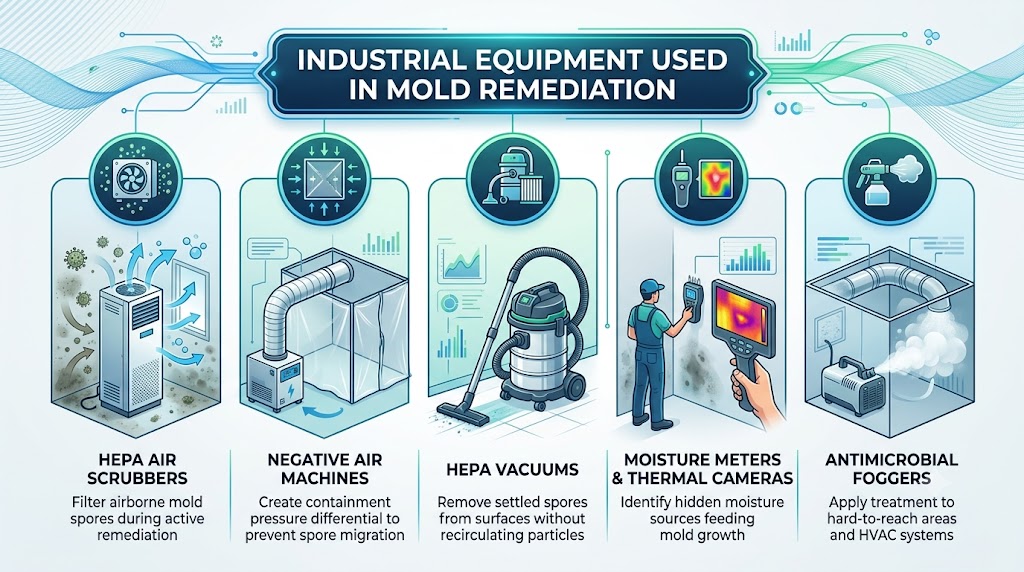
| Equipment | Function |
|---|---|
| HEPA Air Scrubbers | Filter airborne mold spores during active remediation |
| Negative Air Machines | Create containment pressure differential to prevent spore migration |
| HEPA Vacuums | Remove settled spores from surfaces without recirculating particles |
| Moisture Meters & Thermal Cameras | Identify hidden moisture sources feeding mold growth |
| Antimicrobial Foggers | Apply treatment to hard-to-reach areas and HVAC systems |
Cost Breakdown by Project Scope
- Small, contained area (under 10 sq ft): $500–$1,500
- Moderate remediation (single room, 10–100 sq ft): $2,000–$6,000
- Extensive remediation (multiple rooms, crawlspace, or attic): $6,000–$20,000
- Whole-house or severe structural mold: $20,000–$40,000+
Cost drivers include the extent of contamination, whether HVAC systems are affected, accessibility of the affected area (crawlspaces and attics typically cost more), and whether structural materials require replacement rather than surface treatment.
Mold Remediation vs. Mold Removal: An Important Distinction
Reputable remediation companies use the term “remediation” rather than “removal” because mold spores exist naturally in virtually all indoor and outdoor environments — the goal of professional remediation is to return spore counts to normal, ambient levels and eliminate active colonization, not to achieve an impossible standard of zero mold spores. Be cautious of any company promising complete mold “elimination,” as this claim is not scientifically accurate and may indicate an inexperienced provider.
How to Choose a Mold Remediation Contractor
- Is the company IICRC certified in mold remediation (AMRT certification)?
- Do they use an independent third-party testing lab for pre- and post-remediation air quality verification, rather than self-verifying their own work?
- Do they provide a detailed written scope of work before beginning, including containment protocols?
- Are they licensed for mold assessment/remediation in states that require separate licensing (several states, including Florida and Texas, mandate this)?
- Do they address the underlying moisture source, not just the visible mold?
Insurance Coverage for Mold Remediation
Homeowners insurance coverage for mold remediation varies significantly and is often limited or excluded, particularly for mold resulting from long-term humidity or neglected maintenance. Mold resulting from a sudden, covered water event (such as a burst pipe) is more likely to be covered, though many policies cap mold remediation coverage at a specific dollar amount regardless of cause. Reviewing your specific policy language and consulting with your insurance agent before an issue arises is strongly recommended.
Common Mistakes Homeowners Make During Mold Remediation
A frequent and costly mistake is attempting to clean extensive mold growth with bleach alone; bleach is largely ineffective on porous materials like drywall and wood because it cannot penetrate deeply enough to kill mold at the root, often leaving the underlying colonization intact even though the visible surface appears cleaned. Another common error is skipping proper containment during DIY or even some lower-quality professional remediation attempts, which can inadvertently spread spores to previously unaffected areas of the home through disturbed air currents during cleanup. Homeowners should also be cautious of companies that both diagnose the mold problem and self-verify their own remediation work is complete, since this creates a potential conflict of interest; independent third-party post-remediation testing provides a more objective confirmation that the work was successful. Finally, addressing visible mold without identifying and correcting the underlying moisture source is one of the most common reasons for recurrence, since mold will return to any environment that continues to provide the moisture it needs to grow.
Regional Humidity and Mold Risk Factors
Mold risk varies considerably based on regional climate. Homes in the humid Southeast and Gulf Coast face elevated year-round mold risk due to high ambient humidity, which can promote growth even without an obvious water intrusion event, making proper HVAC dehumidification and ventilation particularly important in these regions. The Pacific Northwest’s persistent rainfall and moisture creates elevated risk for exterior-related mold issues, particularly around poorly maintained gutters, siding, and crawlspace ventilation. Homes with basements or crawlspaces in virtually any region face elevated below-grade moisture risk, since these spaces are naturally more prone to humidity accumulation and are often less visually monitored than above-grade living spaces, allowing mold issues to develop and progress before being noticed.
Mold and Indoor Air Quality: Beyond Visible Growth
Even in the absence of visible mold growth, elevated indoor humidity and inadequate ventilation can contribute to broader indoor air quality concerns, including elevated dust mite populations and general allergen accumulation. Homeowners concerned about indoor air quality more broadly, not just visible mold, may benefit from a comprehensive indoor air quality assessment that measures humidity levels, airflow, and particulate concentration throughout the home, in addition to any specific mold testing. Addressing whole-home humidity control — through properly sized HVAC dehumidification, bathroom and kitchen exhaust ventilation, and crawlspace or basement moisture management — provides a broader preventive benefit against mold risk than addressing isolated problem areas alone.
Reading a Mold Remediation Proposal Like a Professional
A trustworthy mold remediation proposal should specify the exact containment approach (physical barriers, negative air pressure level), the specific materials proposed for removal versus cleaning-in-place, and which independent laboratory will perform post-remediation verification testing. Be wary of proposals that bundle testing and remediation from the same company without an independent verification step, since this creates a conflict of interest in confirming the work was actually successful. Request that the proposal explicitly identify the suspected moisture source and the specific corrective action planned to address it, since remediation without addressing the root cause is incomplete regardless of how thoroughly the visible mold itself is treated. Finally, confirm what happens if post-remediation testing doesn’t pass — a reputable company should include a plan for additional work at no extra charge if their initial remediation doesn’t achieve acceptable air quality results, rather than treating this as a new billable project.
Making the Final Decision Under Time Pressure
Because mold issues tend to worsen the longer they’re left unaddressed, and because contamination can spread beyond the initially visible area if not promptly contained, homeowners identifying a potential mold issue are generally best served by moving relatively quickly to schedule a professional assessment rather than extensively delaying the decision. That said, “quickly” doesn’t mean skipping the due diligence of confirming IICRC certification and requesting a clear written scope of work; a reputable remediation company should be able to schedule an assessment within a few days for non-emergency situations while still providing the documentation and certification confirmation needed to make an informed contractor selection.
Coordinating Mold Remediation With Real Estate Transactions
Mold issues discovered during a home inspection can significantly complicate a real estate transaction, often becoming a point of renegotiation or a deal-breaker if not addressed. Sellers who proactively remediate a known mold issue with proper IICRC-certified documentation and post-remediation verification testing are generally in a much stronger negotiating position than those who attempt to conceal or ignore the issue, since undisclosed mold problems discovered later can create legal liability in many states that require sellers to disclose known material defects. Buyers, meanwhile, are well served by requesting any available remediation and verification records during due diligence rather than relying solely on a visual walkthrough, since a professionally documented resolution provides considerably more assurance than the mere absence of visible mold at the time of inspection, particularly for a property with any known history of water intrusion.
Key Terms Glossary
- AMRT Certification: The IICRC’s Applied Microbial Remediation Technician credential, the primary industry qualification for mold remediation professionals.
- HEPA (High-Efficiency Particulate Air): A filtration standard capable of capturing extremely small particles, including mold spores, used in air scrubbers and vacuums during remediation.
- Negative Air Pressure: A containment technique using specialized equipment to keep air pressure lower inside a work area than outside, preventing spore migration.
- Post-Remediation Verification (PRV): Independent testing performed after remediation to confirm mold spore counts have returned to acceptable, normal ambient levels.
Frequently Asked Questions
Can I remediate small areas of mold myself?
The EPA generally states that areas smaller than about 10 square feet can be addressed by a homeowner using proper protective equipment and standard cleaning products, while larger areas warrant professional remediation. When in doubt about whether an affected area exceeds this threshold, or if the mold has resulted from a significant water intrusion event, erring toward a professional assessment is generally the safer approach, given the relatively modest cost of an inspection compared to the potential cost of an incomplete DIY remediation that later requires a full professional re-treatment of a larger, spread area — a scenario that’s unfortunately common when initial DIY attempts inadvertently disturb and spread spores without proper containment.
How long does professional mold remediation take?
Most residential projects take 3–7 days depending on the extent of contamination, containment requirements, and any necessary material replacement.
Will mold come back after remediation?
Mold will return if the underlying moisture source isn’t corrected. Reputable remediation always includes identifying and addressing the root cause, not just treating visible growth.
Is testing necessary before remediation?
For visible mold with a known moisture source, testing isn’t always required before remediation begins, though post-remediation verification testing is strongly recommended to confirm the work was successful.
What health symptoms are associated with mold exposure?
Common symptoms include respiratory irritation, coughing, worsening allergy or asthma symptoms, and headaches, though sensitivity varies significantly between individuals; anyone with persistent symptoms should consult a physician.
How much does post-remediation verification testing typically cost?
Independent third-party air quality verification testing generally costs $300-$600 depending on the number of samples collected and the laboratory used, and is a worthwhile investment for confirming remediation was successful, particularly for larger or more extensive remediation projects.
Can mold grow inside HVAC ductwork, and how is that addressed?
Yes, HVAC systems can develop mold growth, particularly in humid climates or when condensation accumulates in ductwork; this typically requires specialized duct cleaning and treatment in addition to standard remediation, and should be specifically evaluated if musty odors seem to originate from HVAC vents.
Get a Professional Mold Assessment
If you suspect mold growth in your home, prompt professional assessment helps prevent both health risks and escalating remediation costs. Request quotes and inspection reports from at least two IICRC-certified remediation companies, and insist on independent post-remediation air quality verification as part of any contract. This article may contain affiliate links to vetted mold remediation contractor-matching services; we may earn a commission if you request a quote through these links, at no additional cost to you.
Advertisement