
Foundation Problems Are an Engineering Issue, Not a Cosmetic One
Cracked walls, sticking doors, uneven floors, and gaps around window frames are often dismissed as minor cosmetic issues, but they are frequently early warning signs of foundation movement. Left unaddressed, foundation settlement can compromise structural integrity, reduce property value, and in severe cases render a home unsafe to occupy. Fortunately, the foundation repair industry has evolved dramatically over the past two decades, moving from crude mudjacking techniques to precision-engineered, industrial-grade systems capable of stabilizing and even lifting structures back toward their original elevation.
Advertisement
This guide explains how modern foundation repair systems work, what they cost, how to distinguish a legitimate structural engineering solution from a low-quality patch job, and how to select a qualified contractor for a repair that will last the lifetime of your home.
Common Warning Signs of Foundation Movement
- Diagonal cracks in drywall, particularly above doors and windows
- Doors and windows that stick or no longer close properly
- Visible cracks in exterior brick or block, especially stair-step patterns
- Uneven or sloping floors, noticeable with a level or rolling ball test
- Gaps between walls and ceilings or between walls and floor trim
- Bowing or leaning basement walls
Foundation Repair Methods Compared
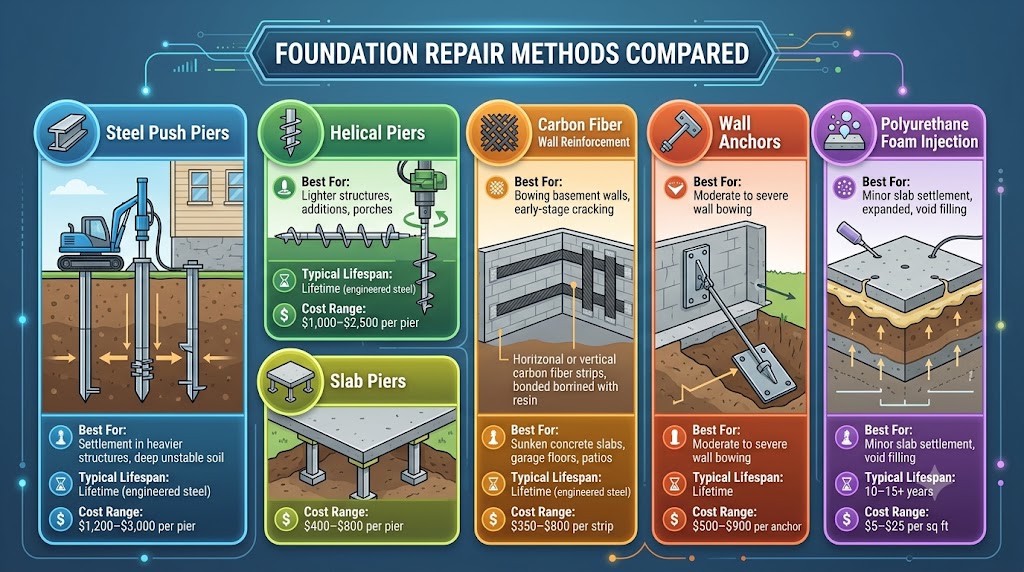
| Method | Best For | Typical Lifespan | Cost Range |
|---|---|---|---|
| Steel Push Piers | Settlement in heavier structures, deep unstable soil | Lifetime (engineered steel) | $1,200–$3,000 per pier |
| Helical Piers | Lighter structures, additions, porches | Lifetime (engineered steel) | $1,000–$2,500 per pier |
| Slab Piers | Sunken concrete slabs, garage floors, patios | Lifetime (engineered steel) | $400–$800 per pier |
| Carbon Fiber Wall Reinforcement | Bowing basement walls, early-stage cracking | Lifetime | $350–$800 per strip |
| Wall Anchors | Moderate to severe wall bowing | Lifetime | $500–$900 per anchor |
| Polyurethane Foam Injection | Minor slab settlement, void filling | 10–15+ years | $5–$25 per sq ft |
Push Piers vs. Helical Piers: Which Does Your Home Need?
This is the single most common technical question homeowners face when comparing quotes. Push piers are hydraulically driven deep into load-bearing soil or bedrock and are generally used on heavier structures where the weight of the home itself helps drive the pier to refusal depth. Helical piers are mechanically screwed into the ground and are better suited to lighter structures — additions, porches, and decks — where there isn’t enough structural weight to properly seat a push pier. A qualified structural engineer or foundation specialist should evaluate your specific soil conditions and structural load before recommending one method over the other; be cautious of any contractor who proposes a single method without first performing this evaluation.
The Foundation Repair Process, Step by Step
- Initial inspection and evaluation: A foundation specialist assesses cracking patterns, measures floor elevation, and identifies the likely cause (soil expansion, drainage issues, poor original construction, tree root intrusion).
- Engineering assessment: For significant movement, a structural engineer’s report may be required, particularly for insurance claims or real estate transactions.
- Pier placement plan: The contractor determines the number and spacing of piers needed based on structural load calculations.
- Installation: Piers are driven or screwed to load-bearing depth, then connected to steel brackets under the foundation footing.
- Lift and stabilization: Hydraulic jacks attempt to lift the structure back toward its original position, when structurally safe to do so.
- Final documentation: A reputable contractor provides engineering documentation and a transferable warranty for your records.
What Drives Total Project Cost
- Number of piers required: Determined by the linear footage of affected foundation and structural load, typically ranging from 6–20+ piers for a full perimeter stabilization.
- Soil and access conditions: Difficult excavation, landscaping removal, or limited equipment access increases labor cost.
- Severity of movement: Early-stage cracking is far less expensive to address than severe, multi-inch settlement requiring extensive lifting.
- Drainage correction: Many reputable contractors will not warranty a repair unless underlying drainage issues are also corrected, which can add $2,000–$8,000 to a project.
How to Vet a Foundation Repair Contractor
The foundation repair industry unfortunately includes a significant number of underqualified operators. Protect your investment by confirming the following before signing any contract:
- Does the company employ or work directly with a licensed structural engineer?
- Is the proposed pier system independently engineered, with load calculations specific to your home?
- Does the warranty transfer to future homeowners, and is it backed by a manufacturer or only the local contractor?
- Can they provide documented before/after elevation surveys from prior projects?
- Are they licensed and insured in your state specifically for foundation and structural repair work?
Insurance, Financing, and Real Estate Implications
Standard homeowners insurance policies typically do not cover foundation settlement caused by soil movement, as this is considered a maintenance issue rather than a sudden covered peril. However, financing options specifically for foundation repair are widely available, often through partnerships between repair companies and home improvement lenders, with terms ranging from 12 to 144 months. For homeowners preparing to sell, an unresolved foundation issue can significantly complicate a transaction; obtaining a repair with a transferable lifetime warranty prior to listing is generally the more effective strategy than disclosing an unaddressed problem.
Common Mistakes Homeowners Make When Addressing Foundation Issues
The most damaging mistake is delaying repair after noticing warning signs, hoping the issue will stabilize on its own. Foundation movement is rarely self-correcting, and the cost of repair generally increases with the severity of settlement, since more piers and more extensive lifting work are required to address advanced movement compared to early-stage cracking. Another common error is accepting a single contractor’s diagnosis and pier-count recommendation without a second opinion, particularly for larger repairs — given the significant dollar amounts involved, a second independent assessment, ideally from a company with an in-house or consulting structural engineer, can confirm whether the proposed scope is appropriate or unnecessarily extensive. Homeowners should also avoid contractors who propose polyurethane foam injection as a fix for significant structural settlement; foam injection is appropriate for minor slab leveling and void filling, but it is not a substitute for engineered pier systems when genuine structural settlement is occurring. Finally, ignoring the underlying drainage cause of foundation movement — often poor grading, clogged gutters, or a leaking irrigation line near the foundation — frequently leads to recurring settlement even after piers are installed, since the piers address the symptom but not necessarily the ongoing moisture source.
Regional Soil Conditions and Foundation Risk
Foundation repair needs vary significantly by regional soil composition. Expansive clay soils, common throughout Texas, Oklahoma, and much of the southern and central United States, swell significantly when wet and shrink when dry, creating repeated cyclical stress on foundations that is a leading cause of settlement in these regions. Homes built on fill soil or reclaimed land, common in parts of the Gulf Coast and certain coastal developments, face elevated settlement risk due to inconsistent soil compaction beneath the original construction. In regions with significant freeze-thaw cycles, frost heave can cause seasonal foundation movement as soil beneath and around the foundation expands when it freezes. Homeowners in these higher-risk regions should consider a proactive foundation inspection every few years, even without visible warning signs, particularly for homes over 15-20 years old, since early intervention is consistently less expensive than addressing advanced settlement.
Structural Engineering Reports: What They Actually Include
For significant foundation movement, particularly cases involving insurance claims or real estate transactions, a formal structural engineering report provides independent, professionally stamped documentation of the foundation’s condition and recommended repair scope. A thorough report typically includes elevation survey data mapping the degree of settlement across the foundation, an assessment of the likely cause, specific pier type and spacing recommendations with supporting load calculations, and photographic documentation of visible distress. This documentation carries significant weight in real estate negotiations and insurance disputes, and is generally worth the additional cost (typically $400-$800 for an independent engineering assessment) compared to relying solely on a repair contractor’s in-house evaluation, which may have an inherent incentive to recommend a larger repair scope than strictly necessary.
Reading a Foundation Repair Proposal Like a Professional
A trustworthy foundation repair proposal should include a diagram showing exact proposed pier locations and spacing along the affected foundation, along with the specific pier type, diameter, and estimated depth to load-bearing capacity, rather than a vague total price for “foundation stabilization.” Request documentation of the load calculation supporting the number of piers proposed, and ask specifically whether a licensed structural engineer reviewed and stamped the repair plan, since this stamped documentation carries significant weight for both insurance and future real estate purposes. The proposal should clearly separate the cost of structural repair from any recommended drainage correction work, since bundling these together without itemization makes it difficult to evaluate whether the pricing for each component is reasonable. Finally, confirm in writing whether the warranty is transferable to future homeowners and whether it’s backed by the pier manufacturer directly or only by the local contractor, since a manufacturer-backed warranty generally provides more durable protection if the local company were to go out of business in future years.
Making the Final Decision
Foundation repair decisions are rarely optional in the way many other home improvement projects are — once genuine structural settlement is confirmed, the primary decision is timing and contractor selection rather than whether to proceed at all, since deferred structural issues typically worsen and become more costly over time. Homeowners weighing multiple engineered proposals should focus their comparison on the underlying technical documentation — load calculations, pier specifications, and warranty terms — rather than price alone, since the cheapest proposal on paper isn’t always the one that resolves the underlying structural issue most reliably over the long term.
Key Terms Glossary
- Push Pier: A steel pier hydraulically driven into load-bearing soil, using the structure’s own weight to help reach refusal depth.
- Helical Pier: A steel pier with a helix-shaped plate mechanically screwed into the ground, suited to lighter structures like additions and porches.
- Refusal Depth: The point at which a pier can no longer be driven or screwed further because it has reached sufficiently load-bearing soil or bedrock.
- Expansive Soil: Clay-rich soil that swells significantly when wet and shrinks when dry, a common cause of cyclical foundation movement.
Frequently Asked Questions
How do I know if my foundation issue is serious?
Cracks wider than 1/4 inch, stair-step cracking in masonry, doors that no longer latch, or more than 1 inch of floor slope across 20 feet are generally considered signs warranting a professional structural evaluation.
Can a settled foundation actually be lifted back to level?
In many cases, yes, particularly with push pier and helical pier systems, though the degree of achievable lift depends on the severity and age of the settlement, and a structural engineer will advise on safe lift limits.
How much does full-perimeter foundation repair typically cost?
Whole-home stabilization projects commonly range from $10,000 to $40,000 depending on the number of piers required and site conditions, though smaller localized repairs can cost significantly less.
Will foundation repair increase my home’s resale value?
A documented, professionally engineered repair with a transferable warranty generally protects resale value and can prevent a foundation issue from becoming a deal-breaker during a home inspection.
How long does foundation pier installation take?
Most residential foundation repair projects are completed within 1–5 days, depending on the number of piers and site accessibility.
Should I get a second opinion before committing to a foundation repair?
For any repair involving more than a handful of piers or a total cost above a few thousand dollars, a second opinion from an independent structural engineer is generally a worthwhile investment, given the significant cost difference that can exist between an appropriately scoped repair and an unnecessarily extensive one.
Will insurance ever cover foundation repair?
Standard policies typically exclude gradual settlement, but coverage may apply if the damage resulted from a sudden, covered peril such as a plumbing leak that caused rapid soil erosion beneath the foundation; reviewing your specific policy language with your agent is the best way to understand your coverage.
Request a Free Structural Evaluation
Foundation issues rarely improve on their own, and delaying repair typically increases both the scope and cost of the eventual fix. Request evaluations from at least two or three qualified, engineer-backed foundation repair companies before making a decision, and always insist on documented engineering calculations rather than a verbal estimate. This article may contain affiliate links to vetted foundation repair contractor-matching services; we may earn a commission if you request a quote through these links, at no additional cost to you.
Advertisement