
The Rise of Home Battery Storage
Home battery storage systems have evolved rapidly from a niche solar-pairing accessory into a standalone category of home energy infrastructure. Whether paired with solar panels or installed independently as grid backup, commercial-grade lithium battery systems now offer homeowners a genuine alternative — or complement — to traditional fuel-based generators, with the added benefits of silent operation, zero emissions, and integration with smart home energy management. This guide covers the technology, sizing, cost, and selection criteria homeowners need to make an informed decision.
Advertisement
How Home Battery Storage Systems Work
A home battery storage system stores electricity — either from solar panels or from the grid during low-cost periods — in lithium iron phosphate (LFP) or similar battery chemistry, then discharges that stored energy to power the home during outages, peak demand periods, or times when solar production is unavailable. Systems are managed by an inverter and control system that automatically switches between grid, solar, and battery power sources, often with mobile app monitoring allowing homeowners to track production, consumption, and battery state of charge in real time.
Battery Storage vs. Generator: Key Differences
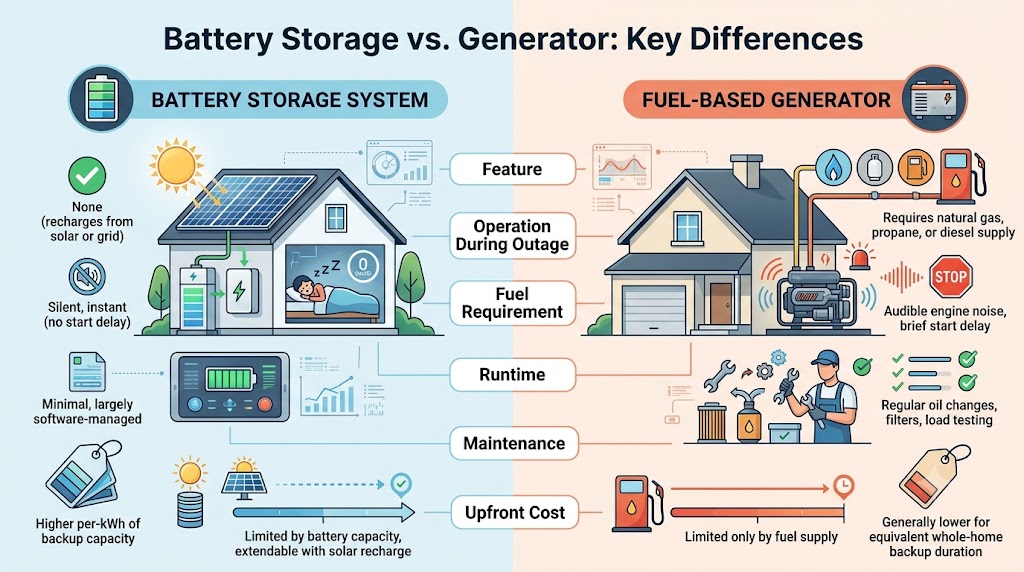
| Feature | Battery Storage System | Fuel-Based Generator |
|---|---|---|
| Operation During Outage | Silent, instant (no start delay) | Audible engine noise, brief start delay |
| Fuel Requirement | None (recharges from solar or grid) | Requires natural gas, propane, or diesel supply |
| Runtime | Limited by battery capacity, extendable with solar recharge | Limited only by fuel supply |
| Maintenance | Minimal, largely software-managed | Regular oil changes, filters, load testing |
| Upfront Cost | Higher per-kWh of backup capacity | Generally lower for equivalent whole-home backup duration |
Sizing a Home Battery System
Battery capacity is measured in kilowatt-hours (kWh), representing total stored energy, while power output is measured in kilowatts (kW), representing how much load the system can support simultaneously. Correct sizing requires understanding both your home’s typical daily energy consumption and your critical load requirements during an outage. Many homeowners choose a “partial home backup” configuration — covering essential circuits like refrigeration, well pumps, and select outlets — rather than whole-home backup, which requires substantially more battery capacity and cost.
- Single battery unit (10–13.5 kWh): Typically covers partial home backup for 8–24 hours depending on load.
- Two-battery system (20–27 kWh): Covers more extensive partial backup or short whole-home backup for smaller, efficient homes.
- Three or more batteries (30+ kWh): Approaches whole-home backup capability for larger homes, particularly when paired with solar recharge capability.
Installed Cost Breakdown
- Single battery unit with inverter/installation: $9,000–$16,000
- Multi-battery system (2–3 units): $18,000–$40,000
- Battery system paired with new solar installation: Combined costs typically range $35,000–$85,000 depending on system size
- Standalone battery (no solar, grid-charging only): Similar equipment cost, though value proposition differs since the battery isn’t offsetting daytime electricity costs
Battery Chemistry: Why LFP Has Become the Standard
Most commercial-grade home battery systems now use lithium iron phosphate (LFP) chemistry rather than the nickel manganese cobalt (NMC) chemistry common in earlier consumer electronics batteries. LFP offers superior thermal stability (lower fire risk), longer cycle life — typically rated for 6,000–10,000 charge cycles compared to 2,000–4,000 for older chemistries — and doesn’t rely on cobalt, which has both cost and supply chain advantages. When evaluating systems, confirming battery chemistry and cycle life warranty terms is one of the most important technical comparisons homeowners can make.
Time-of-Use Optimization and Demand Response
Beyond outage backup, battery storage systems in many markets can be configured to charge during low-cost, off-peak electricity periods and discharge during expensive peak demand periods, reducing overall electricity costs even without an active outage. Some utilities also offer demand-response program participation, where the utility can draw on a portion of a homeowner’s stored battery capacity during grid stress events in exchange for bill credits or incentive payments — a growing monetization avenue for battery-owning homeowners worth researching in your specific utility territory.
How to Choose a Battery Storage Installer
- Is the installer certified by the battery manufacturer, and do they hold appropriate electrical licensing in your state?
- Does the proposal include a clear critical-load calculation determining which circuits will be backed up?
- What is the battery cycle life and capacity degradation warranty (industry standard is typically 10 years with a specified minimum retained capacity)?
- Do they provide monitoring software that allows you to track performance and troubleshoot remotely?
- If pairing with solar, do they have documented experience integrating battery storage with your specific inverter and panel configuration?
Incentives and Financing
Battery storage systems, particularly when paired with solar, may qualify for the federal solar investment tax credit as well as state-specific storage incentive programs, some of which apply even to standalone battery installations without new solar. Given the meaningful investment involved, homeowners should research all applicable incentive programs and financing options — including solar loans, which often can be structured to include battery storage — before finalizing a system size and configuration.
Common Mistakes Homeowners Make When Choosing Battery Storage
A frequent mistake is purchasing battery capacity based on a generic “average household” recommendation rather than an actual analysis of the specific circuits and appliances the homeowner wants backed up during an outage, which can result in either an undersized system that can’t support genuinely critical loads or an oversized, unnecessarily expensive system providing capacity the homeowner doesn’t actually need. Another common error is assuming all lithium battery chemistries perform and age similarly; older or lower-cost NMC chemistry batteries generally have shorter cycle life and somewhat higher fire risk profiles compared to modern LFP chemistry, making this a meaningful technical distinction worth confirming rather than assuming all “lithium battery” marketing claims are equivalent. Homeowners should also avoid installers who don’t clearly document the critical load calculation underlying their system size recommendation, since this calculation is the foundation of whether the proposed system will actually meet the homeowner’s backup power goals during a real outage. Finally, overlooking utility interconnection and permitting timelines when planning an installation can lead to unrealistic expectations about how quickly a system can be activated after signing a contract, particularly in areas with lengthy utility approval processes.
Regional Battery Storage Considerations
Battery storage value proposition varies meaningfully by region based on local electricity rate structures, outage frequency, and available incentive programs. States with significant time-of-use rate differentials between peak and off-peak electricity pricing offer stronger financial return from battery arbitrage strategies, independent of backup power value alone. Regions with frequent extreme weather-related outages, including hurricane-prone coastal states and wildfire-prone western states subject to Public Safety Power Shutoff events, see particularly strong homeowner interest in battery storage specifically for its silent, reliable backup capability during increasingly common grid disruption events. Some states also offer specific battery storage rebate or incentive programs beyond the federal tax credit, which can meaningfully improve the financial case for a system; researching your specific state and utility’s current programs is an important step before finalizing a system size and budget.
Battery Storage and Grid Independence: Setting Realistic Expectations
While battery storage systems, particularly when paired with solar, offer meaningful energy independence benefits, homeowners should set realistic expectations about the difference between “backup power” and true “off-grid” capability. A properly sized battery-solar system can provide substantial resilience during outages and reduce reliance on grid electricity during normal operation, but achieving genuine indefinite off-grid capability — particularly through extended periods of low sun availability — typically requires a considerably larger and more expensive system than what most grid-connected homeowners install for standard backup and cost-optimization purposes. Being clear about your specific goals, whether that’s basic outage protection for critical circuits or more ambitious energy independence, helps ensure the system design and budget align with realistic expectations from the outset.
Reading a Battery Storage Proposal Like a Professional
A trustworthy battery storage proposal should specify the exact battery model, chemistry (confirm LFP versus older NMC chemistry), total usable kWh capacity, and continuous power output rating in kW, rather than a vague reference to “backup battery system.” Confirm the proposal includes a documented critical load calculation identifying exactly which circuits will be backed up and for approximately how long under typical usage, since this is the core promise the system needs to deliver on during an actual outage. Request the manufacturer’s cycle life and capacity degradation warranty terms in writing, and clarify whether the quoted price includes the necessary inverter or requires a separate compatible inverter purchase, since this is a common point of confusion and unexpected additional cost. Finally, if pairing with solar, confirm the proposal addresses how the battery and solar systems will be integrated and controlled, since poor integration between components from different manufacturers can occasionally create compatibility or performance issues that a single, cohesively designed system avoids.
Key Terms Glossary
- LFP (Lithium Iron Phosphate): A battery chemistry favored in modern home storage systems for its thermal stability, long cycle life, and lower fire risk compared to older chemistries.
- Cycle Life: The number of charge/discharge cycles a battery can undergo before its capacity degrades below a specified threshold, typically 6,000-10,000 cycles for LFP systems.
- Critical Load: The specific set of circuits or appliances a homeowner chooses to keep powered during an outage in a partial-home backup configuration.
- Demand Response: A utility program allowing access to a portion of a homeowner’s stored battery capacity during grid stress events in exchange for bill credits or payments.
Frequently Asked Questions
Can I add battery storage without installing solar panels?
Yes, standalone battery systems that charge from the grid are increasingly common, particularly for homeowners primarily seeking silent, reliable backup power rather than long-term energy cost reduction. Some homeowners choose this configuration as an interim step, adding solar panels in a later phase once the initial battery investment has been made and budget allows for the additional expansion, an approach that spreads the total investment across a more manageable timeline for many households.
How long do home batteries last before needing replacement?
Most commercial-grade LFP battery systems are warrantied for 10 years and rated for thousands of charge cycles, with many systems expected to retain meaningful capacity for 12–15+ years of typical residential use.
Can a battery system power my whole house during an extended outage?
This depends on battery capacity relative to your home’s load and whether the system can recharge via paired solar panels; battery-only systems without solar recharge are limited by total stored capacity, while solar-paired systems can potentially sustain backup indefinitely under adequate sun conditions.
Is battery storage or a generator the better backup power investment?
Many homeowners in areas with frequent short outages and available solar potential favor battery storage for its silent, fuel-free operation, while homeowners needing extended multi-day backup capability, particularly without solar, often find a generator or hybrid battery-generator system more cost-effective.
Do home batteries require ongoing maintenance?
Battery systems require minimal physical maintenance compared to generators, though periodic monitoring of system health through the manufacturer’s app and occasional firmware updates are recommended.
What happens to unused battery capacity if I never experience an outage?
In grid-connected configurations, unused stored capacity can typically still be used for time-of-use rate optimization or, where available, demand-response program participation, meaning the system continues providing financial value even during periods without a power outage.
How does battery storage sizing differ for whole-home versus partial-home backup?
Whole-home backup requires calculating and supporting your home’s full simultaneous electrical load, including high-draw appliances like central air conditioning, which typically requires significantly more battery capacity and often multiple battery units, while partial-home backup focuses only on a defined set of critical circuits, allowing a smaller and less expensive system to meet the homeowner’s core backup priorities.
Get a Custom Battery Storage Assessment
Because the right battery configuration depends heavily on your home’s energy consumption patterns, backup priorities, and whether solar pairing is part of your plan, a detailed site assessment from a certified installer is the best starting point. Request proposals from multiple certified battery storage installers to compare system sizing, warranty terms, and total installed cost. This article may contain affiliate links to vetted battery storage installer-matching services; we may earn a commission if you request a quote through these links, at no additional cost to you.
Advertisement