
When Residential Flooring Isn’t Built to Last
Large families, pets, home-based businesses, rental properties, and high-traffic areas like mudrooms, kitchens, and basements routinely outlast the wear rating of standard residential flooring products. Commercial-grade flooring — engineered for the continuous foot traffic of offices, retail spaces, and healthcare facilities — offers substantially higher durability, easier maintenance, and often better lifetime value for homeowners dealing with heavy use, even though it carries a different aesthetic profile than typical big-box residential flooring lines.
Advertisement
Commercial-Grade Flooring Options Compared
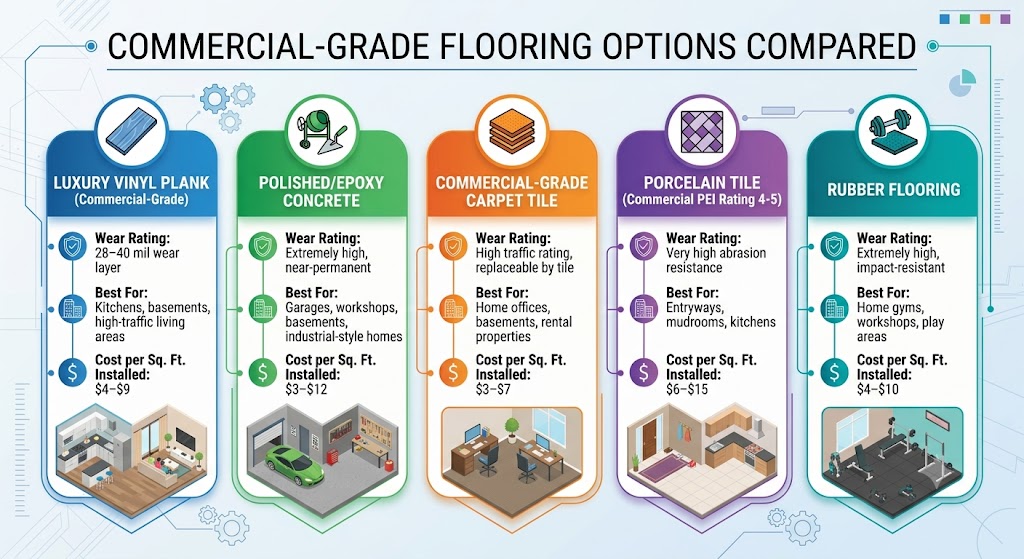
| Material | Wear Rating | Best For | Cost per Sq. Ft. Installed |
|---|---|---|---|
| Luxury Vinyl Plank (Commercial-Grade) | 28–40 mil wear layer | Kitchens, basements, high-traffic living areas | $4–$9 |
| Polished/Epoxy Concrete | Extremely high, near-permanent | Garages, workshops, basements, industrial-style homes | $3–$12 |
| Commercial-Grade Carpet Tile | High traffic rating, replaceable by tile | Home offices, basements, rental properties | $3–$7 |
| Porcelain Tile (Commercial PEI Rating 4-5) | Very high abrasion resistance | Entryways, mudrooms, kitchens | $6–$15 |
| Rubber Flooring | Extremely high, impact-resistant | Home gyms, workshops, play areas | $4–$10 |
Understanding Wear Ratings and Durability Metrics
Commercial flooring products are rated using standardized industry metrics that most residential-grade products don’t disclose or don’t meet. Luxury vinyl plank wear layers are measured in mils, with commercial-grade products typically starting at 20 mils and reaching 40+ mils for heavy commercial use, compared to 6–12 mil wear layers common in budget residential products. Porcelain and ceramic tile use the PEI (Porcelain Enamel Institute) rating scale from 0–5, with PEI 4-5 indicating suitability for heavy commercial foot traffic. Understanding these ratings allows homeowners to make an apples-to-apples comparison when evaluating flooring options rather than relying on marketing terms alone.
Best Applications for Commercial-Grade Flooring in Homes
- Mudrooms and entryways: Highest-traffic, highest-abrasion areas in most homes, ideal for PEI 4-5 porcelain tile or heavy-wear LVP.
- Kitchens: Combination of foot traffic, moisture, and dropped-object impact make commercial-grade LVP or polished concrete strong choices.
- Basements and workshops: Polished or epoxy-coated concrete provides near-indestructible, moisture-tolerant flooring ideal for utility and hobby spaces.
- Home offices and multi-use rental properties: Commercial carpet tile allows individual tile replacement when sections wear or stain, extending overall floor life significantly compared to broadloom carpet.
- Home gyms: Rubber flooring provides impact absorption and durability unmatched by standard residential flooring options.
Cost and Value Comparison Over Time
While commercial-grade materials often carry a modest upfront cost premium compared to entry-level residential products, their extended lifespan frequently results in lower cost-per-year of ownership. For example, budget residential LVP with a thin wear layer may require replacement within 7–10 years in a high-traffic area, while commercial-grade LVP with a 28+ mil wear layer can perform well for 15–20+ years under the same conditions — a meaningful long-term value consideration for homeowners planning to stay in their property for many years.
Installation Considerations
Commercial-grade flooring materials sometimes require different subfloor preparation and installation techniques than standard residential products — polished concrete, for example, requires specialized grinding and sealing equipment, while commercial LVP often benefits from professional glue-down installation in high-traffic settings rather than the floating floor systems common in residential-only products. Homeowners should confirm their chosen installer has specific experience with the selected commercial-grade material, as improper installation can compromise both appearance and durability regardless of product quality.
How to Choose a Commercial Flooring Contractor
- Does the installer have documented experience with commercial-grade materials specifically, not just standard residential flooring?
- Can they provide manufacturer wear-layer or PEI rating documentation for proposed products?
- Do they offer subfloor moisture testing and preparation appropriate for the selected material, particularly for concrete and glue-down installations?
- What warranty coverage applies to both material and installation labor?
- Can they provide maintenance guidance specific to the chosen commercial-grade product?
Maintenance Requirements
Commercial-grade flooring is generally designed for lower maintenance relative to its durability, but proper care still extends product life meaningfully. Polished concrete typically requires periodic resealing every 1–3 years; commercial LVP benefits from routine sweeping and occasional manufacturer-recommended cleaning products (avoiding harsh solvents that can degrade the wear layer); commercial carpet tile allows spot cleaning and individual tile replacement rather than full-floor replacement when damage occurs.
Common Mistakes Homeowners Make When Selecting Commercial-Grade Flooring
A frequent mistake is selecting a flooring product based on marketing terms like “heavy-duty” or “premium” without requesting the actual manufacturer specification sheet showing wear layer thickness or PEI rating, since these marketing terms aren’t standardized and can vary considerably in actual performance between manufacturers. Another common error is prioritizing appearance alone without considering the specific demands of the installation location; a beautiful matte-finish tile, for example, may not be the right choice for a mudroom that will regularly track in moisture and grit, where a textured, higher-slip-resistance product would perform better despite potentially being a less dramatic design statement. Homeowners should also avoid underestimating subfloor preparation requirements, particularly for polished concrete and glue-down installations, since inadequate moisture testing or surface preparation is a leading cause of installation failure regardless of how high-quality the flooring product itself is. Finally, choosing the lowest bid installer without confirming specific experience with the chosen commercial-grade material can result in installation errors that void manufacturer warranties or compromise the product’s designed durability advantages.
Regional and Climate Considerations for Flooring Selection
Flooring performance requirements vary by regional climate and typical home conditions. Homes in humid climates should prioritize moisture-tolerant materials like luxury vinyl plank or polished concrete in below-grade and high-moisture areas, since materials like traditional hardwood or standard carpet are more prone to moisture-related issues in these conditions. Homes in regions with significant seasonal temperature swings should consider a flooring product’s dimensional stability, since materials like solid hardwood can expand and contract meaningfully with humidity changes, while engineered products and LVP are generally more dimensionally stable across seasonal conditions. Homes with radiant floor heating systems, increasingly common in colder climate custom construction, require flooring products specifically rated for compatibility with radiant heat, which not all flooring materials, particularly some LVP products, are designed to accommodate without risk of degradation.
Sustainability and Indoor Air Quality Considerations
Commercial-grade flooring selection increasingly involves indoor air quality considerations, particularly regarding volatile organic compound (VOC) emissions from adhesives and the flooring material itself. Many commercial-grade products now carry FloorScore or GREENGUARD certification, which independently verifies low VOC emissions, a consideration particularly relevant for households with young children, elderly residents, or individuals with respiratory sensitivities. Homeowners prioritizing indoor air quality should specifically request documentation of these certifications when comparing flooring products, since not all commercial-grade materials meet the same emissions standards despite similar durability performance.
Reading a Flooring Proposal Like a Professional
A trustworthy commercial-grade flooring proposal should specify the exact product name, wear layer thickness (for LVP) or PEI rating (for tile), and manufacturer, allowing you to independently verify performance specifications rather than relying solely on the installer’s characterization of the product. Confirm the proposal includes subfloor preparation scope explicitly — moisture testing, leveling compound, or removal of existing flooring — since this work is often a significant cost driver that can be underestimated or omitted from a lower initial bid, only to surface as a change order once work begins. For glue-down and polished concrete installations, request documentation of the specific adhesive or sealant system proposed and its compatibility with your subfloor type. Finally, clarify what warranty coverage applies to the installation labor itself, separate from the manufacturer’s product warranty, since installation-related issues like improper adhesive application or seam work are generally covered under the installer’s workmanship warranty rather than the manufacturer’s product warranty.
Making the Final Decision: Match Material to Location
Rather than selecting a single flooring material for an entire home, many homeowners achieve the best combination of durability and value by matching specific commercial-grade materials to the specific demands of each area — polished concrete or heavy-wear LVP in basements and mudrooms, PEI 4-5 porcelain tile in entryways and kitchens, and commercial carpet tile in home offices or secondary living spaces where softer underfoot comfort remains a priority. This zone-based approach generally delivers better long-term value than a one-size-fits-all material choice applied uniformly regardless of each area’s actual traffic and moisture exposure profile.
Coordinating Flooring Upgrades With Renovation Timing
Flooring replacement is often most cost-effective when coordinated with other renovation work already underway, since shared labor and material staging can reduce incremental project cost compared to a fully standalone flooring project. Homeowners planning a kitchen or basement renovation should discuss commercial-grade flooring options with their contractor during the initial project scoping, since decisions about subfloor preparation and moisture barriers are often easier and less costly to address while other structural work is already in progress. Coordinating material delivery and installation scheduling across trades also reduces the risk of new flooring being damaged by other ongoing construction activity, an outcome that’s considerably more costly to remedy after the fact than to plan around in advance.
Key Terms Glossary
- Wear Layer: The protective top layer of luxury vinyl plank flooring, measured in mils, that determines its resistance to scratches and abrasion.
- PEI Rating: The Porcelain Enamel Institute’s 0-5 scale rating tile abrasion resistance, with 4-5 indicating suitability for heavy commercial foot traffic.
- FloorScore/GREENGUARD Certification: Independent certifications verifying low volatile organic compound (VOC) emissions from flooring products and adhesives.
- Glue-Down Installation: A flooring installation method using adhesive to permanently bond flooring to the subfloor, common for commercial-grade LVP in high-traffic settings.
Frequently Asked Questions
Is commercial-grade flooring less attractive than residential flooring options?
Modern commercial-grade products, particularly LVP and porcelain tile, are available in a wide range of styles and finishes comparable to residential lines; the performance specifications differ far more than the visual design options available. Homeowners are often surprised by how closely today’s commercial-grade product lines resemble their residential counterparts once they see physical samples side by side, particularly in newer luxury vinyl plank and porcelain tile collections designed with both durability and aesthetics in mind, a reflection of how much the commercial flooring category has evolved in design sophistication over the past decade.
Can commercial-grade flooring be installed over existing residential flooring?
This depends on the specific product and existing floor condition; some LVP products can be installed over existing hard flooring, while polished concrete and tile typically require proper subfloor preparation or removal of existing material.
Is commercial-grade flooring worth it for a typical family home?
For high-traffic areas, homes with large families or pets, or rental properties, the extended durability generally justifies the modest cost premium; for low-traffic formal spaces, standard residential-grade products may be sufficient.
How do I verify a flooring product’s actual commercial-grade rating?
Request manufacturer specification sheets showing wear layer thickness (for LVP) or PEI rating (for tile) rather than relying on marketing descriptions like “heavy duty” or “premium,” which aren’t standardized terms.
Does commercial-grade flooring increase home resale value?
Durable, well-maintained flooring in high-traffic areas is generally viewed favorably by buyers and inspectors, particularly compared to visibly worn budget flooring, though specific resale value impact varies by local market and buyer preferences.
Is polished concrete cold and uncomfortable underfoot compared to other flooring?
Polished concrete can feel cooler than carpet or LVP, though this can be mitigated with area rugs in specific seating areas or by pairing with radiant floor heating for climate-controlled comfort; many homeowners find the durability and low-maintenance benefits outweigh this consideration for utility spaces like basements and workshops.
How do I maintain commercial-grade flooring to maximize its lifespan?
Maintenance varies by material, but generally includes regular sweeping or dust mopping to prevent grit abrasion, prompt cleanup of spills, use of manufacturer-recommended cleaning products rather than harsh solvents, and for polished concrete, periodic resealing on the manufacturer’s recommended schedule.
Get Flooring Quotes From Experienced Commercial-Grade Installers
Because commercial-grade materials and installation techniques differ meaningfully from standard residential flooring work, it’s worth specifically confirming a contractor’s experience with your chosen product category before requesting a final quote. Compare proposals from multiple experienced installers, and request documentation of wear ratings for any product under consideration. This article may contain affiliate links to vetted flooring contractor-matching services; we may earn a commission if you request a quote through these links, at no additional cost to you.
Advertisement