
Why Homeowners Are Choosing Commercial-Grade Solar Equipment
The residential solar market has matured significantly, and many homeowners — particularly those with large roofs, high energy consumption, or properties combining residential and light-commercial use — are now specifying commercial-grade solar components rather than entry-level residential kits. Commercial-grade panels, inverters, and racking systems typically offer higher efficiency ratings, longer warranties, and better performance in demanding conditions, making them a smart long-term investment despite a higher upfront cost.
Advertisement
This guide walks through system types, equipment tiers, realistic installed costs, financing structures, and how to evaluate a solar installer capable of handling a larger, commercial-grade residential project.
Residential-Grade vs. Commercial-Grade Solar Equipment
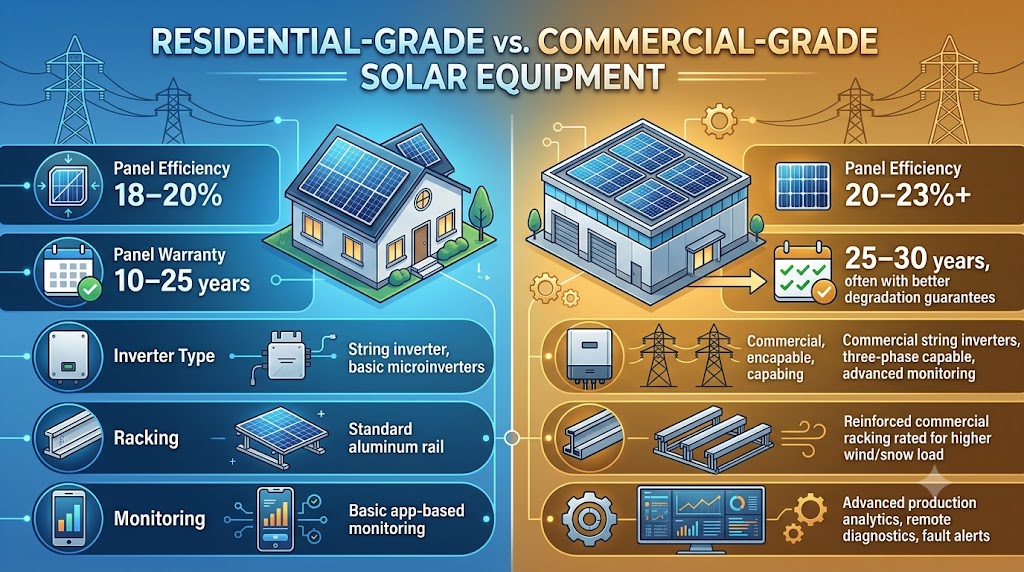
| Component | Residential-Grade | Commercial-Grade |
|---|---|---|
| Panel Efficiency | 18–20% | 20–23%+ |
| Panel Warranty | 10–25 years | 25–30 years, often with better degradation guarantees |
| Inverter Type | String inverter, basic microinverters | Commercial string inverters, three-phase capable, advanced monitoring |
| Racking | Standard aluminum rail | Reinforced commercial racking rated for higher wind/snow load |
| Monitoring | Basic app-based monitoring | Advanced production analytics, remote diagnostics, fault alerts |
System Sizing and Cost Breakdown
Solar system cost is typically quoted per watt installed, and larger commercial-grade systems generally achieve better pricing per watt due to economies of scale. National average ranges before incentives:
- Small system (5–7 kW): $16,000–$24,000
- Mid-size system (8–12 kW): $24,000–$36,000
- Large residential/light-commercial system (15–25 kW): $42,000–$75,000
- Battery storage add-on (10–13.5 kWh): $9,000–$16,000 per battery unit
These figures are before the federal solar investment tax credit and any applicable state or utility incentives, which can meaningfully reduce net project cost. Homeowners should always request an itemized proposal that separates equipment cost, labor, permitting, and any electrical panel upgrade requirements.
Ground-Mount vs. Roof-Mount Commercial Solar Arrays
Properties with sufficient land area increasingly opt for ground-mount solar arrays, which use commercial-grade racking systems similar to utility-scale installations. Ground-mount systems allow optimal panel angling regardless of roof orientation, easier maintenance access, and can accommodate larger commercial-grade panel formats. However, they require more extensive trenching for electrical connections and typically cost 10–20% more per watt than an equivalent roof-mount system due to the additional structural and civil work involved.
Battery Storage: Extending Solar Value
Pairing a solar array with commercial-grade battery storage allows homeowners to store excess daytime production for evening use or grid outages, and in many markets to participate in time-of-use rate arbitrage or utility demand-response programs. Commercial-grade battery systems typically offer higher round-trip efficiency and longer cycle life than basic residential units, which matters significantly given that battery replacement is a major cost over a system’s 25+ year lifespan.
How to Evaluate a Solar Installer
- Is the installer NABCEP certified (North American Board of Certified Energy Practitioners), the industry’s primary credential?
- Do they hold both electrical and solar-specific state licensing?
- Do they provide a detailed production estimate using satellite or on-site shading analysis, not a generic regional average?
- What is the workmanship warranty separate from the manufacturer’s equipment warranty?
- Do they handle interconnection paperwork and utility net-metering applications directly?
- Can they provide references for systems of comparable size, particularly larger commercial-grade residential installations?
Financing Options and Incentive Programs
Most homeowners finance solar installations through one of several structures: cash purchase, solar loan, lease, or power purchase agreement (PPA). Cash purchase and solar loans allow homeowners to claim the federal tax credit directly and generally deliver the best long-term return, while leases and PPAs shift ownership (and the tax credit) to a third party in exchange for lower or no upfront cost. Property owners should also research state-specific incentive programs and net-metering policies, as these vary considerably and significantly affect the payback period of a system.
Maintenance and Long-Term Performance
Commercial-grade solar systems require minimal but important maintenance: periodic panel cleaning, inverter inspection, and monitoring system checks to catch underperforming strings early. Most reputable installers offer a monitoring dashboard that flags production anomalies automatically, allowing issues to be addressed before they meaningfully affect output. Annual professional inspections, typically $150–$400, are recommended to verify electrical connections and racking integrity, particularly in regions with heavy snow load or high wind exposure.
Common Mistakes Homeowners Make When Going Solar
The most frequent mistake is accepting a production estimate based on a generic regional average rather than a site-specific shading and orientation analysis; two neighboring homes can have dramatically different production potential based on roof orientation, pitch, and tree shading, and a generic estimate can lead to unrealistic expectations about the system’s actual payback period. Another common error is signing a long-term lease or power purchase agreement without fully understanding that these arrangements typically transfer the valuable federal tax credit to the third-party owner rather than the homeowner, which significantly changes the total financial picture compared to a cash or loan purchase. Homeowners should also be cautious of high-pressure sales tactics common in door-to-door and phone solar sales, including artificially discounted “today-only” pricing, which is rarely a legitimate reflection of genuine cost variation. Finally, failing to confirm roof condition and remaining lifespan before installing solar is a costly oversight — removing and reinstalling a solar array to accommodate a roof replacement a few years later adds significant unplanned expense that could have been avoided by replacing an aging roof before installation.
Regional Solar Considerations and Net Metering Policy
Solar economics vary considerably by state due to differing net metering policies, which determine how much credit homeowners receive for excess electricity sent back to the grid. States with favorable full-retail-rate net metering generally offer significantly better solar payback periods than states that have transitioned to lower “avoided cost” compensation rates for exported solar energy. Homeowners should research their specific utility’s current net metering policy, as several states have modified these programs in recent years, sometimes with grandfathering provisions for existing solar customers that don’t apply to new installations. Climate also affects system design: homes in regions with significant snow load benefit from steeper panel tilt angles and robust racking systems rated for the additional weight, while homes in high-wind coastal regions require racking systems engineered to meet local wind-uplift requirements.
Solar Panel Degradation and Long-Term Performance Guarantees
All solar panels experience gradual, predictable output degradation over time, typically around 0.3-0.5% annually for premium commercial-grade panels, compared to 0.5-0.8% for lower-tier residential products. Reputable manufacturers provide a performance warranty guaranteeing the panel will retain a specified percentage of its original output — commonly 92% at year 10 and 85% at year 25 — and homeowners should request this documentation as part of any proposal, since not all “25-year warranty” claims cover the same performance guarantee. Understanding this degradation curve is important for accurately projecting long-term energy production and payback calculations, particularly for homeowners planning to own the system for its full useful life.
Reading a Solar Proposal Like a Professional
A trustworthy solar proposal should specify the exact panel and inverter model, total system size in kilowatts (DC), and a site-specific production estimate generated from satellite or on-site shading analysis rather than a generic regional average. Confirm the proposal separates equipment cost, labor, permitting, and any necessary electrical panel upgrade, since bundling these into a single number makes it difficult to compare proposals fairly across installers. Ask specifically about the panel’s performance warranty terms (not just the product warranty), the inverter warranty length (often shorter than the panel warranty and a common point of confusion), and who is responsible for warranty claims processing if either the manufacturer or installer is no longer in business years later. Finally, request documentation of the installer’s plan for utility interconnection and net metering application, since delays in this administrative step are one of the most common causes of extended timelines between installation and system activation.
Making the Final Decision: Total Cost of Ownership
Solar investment decisions benefit from a full lifecycle cost comparison rather than an upfront price comparison alone, since two systems with similar initial cost can deliver meaningfully different total value over a 25-30 year ownership period based on equipment quality, degradation rate, and warranty coverage. A modestly more expensive system using commercial-grade panels with better degradation guarantees and a more robust inverter warranty frequently outperforms a cheaper system on total lifetime production and reliability, particularly for homeowners planning long-term ownership. Building a simple year-by-year projection — factoring in expected production, utility rate inflation, and the system’s degradation curve — provides a more complete picture than comparing sticker prices alone, and a reputable installer should be willing to walk through this projection in detail as part of the sales process. It’s also worth requesting a written breakdown of assumptions behind any projected savings figure, since overly optimistic utility rate inflation assumptions can make a marginal system appear more attractive than it will likely perform in practice, and a transparent installer will readily share this level of underlying detail without hesitation.
Key Terms Glossary
- Net Metering: A billing arrangement crediting solar owners for excess electricity sent back to the grid, with credit rates and structures varying by state and utility.
- Degradation Rate: The annual rate at which a solar panel’s power output declines over its lifespan, typically 0.3-0.8% per year depending on panel quality.
- String Inverter vs. Microinverter: String inverters convert DC to AC power for a group of panels together, while microinverters perform this conversion at each individual panel, offering panel-level optimization.
- Investment Tax Credit (ITC): A federal tax credit available to solar system owners, applicable to the total installed cost of a qualifying system.
- Power Purchase Agreement (PPA): A financing arrangement where a third party owns the solar system and sells the homeowner the electricity it generates at a set rate.
Frequently Asked Questions
Is commercial-grade solar equipment worth the extra cost for a home?
For larger systems and long ownership horizons, yes — higher efficiency panels and more robust inverters typically pay for themselves through better long-term production and reduced replacement risk. Homeowners planning to sell within just a few years may find the calculation less favorable, since a shorter ownership window limits the time available to fully realize the long-term production and reliability advantages of premium equipment, though even shorter-horizon owners often still see reasonable value from mid-tier equipment choices.
How long does a solar installation take from signing to activation?
Typically 2–4 months, factoring in permitting, installation (usually 1–3 days), inspection, and utility interconnection approval, which is often the longest step.
Do commercial-grade solar panels perform better in cloudy or cold climates?
Higher-efficiency panels generally produce more energy per square foot in all conditions, including partial shade or diffuse light, though total production still depends heavily on available sunlight hours.
What is the typical payback period for a solar investment?
Most residential systems pay for themselves in 6–12 years depending on local electricity rates, system cost, and available incentives, with the system continuing to generate savings for the remainder of its 25–30 year lifespan.
Can I add battery storage to an existing solar system later?
In most cases yes, provided the existing inverter is battery-compatible or a second inverter is added; a qualified installer can evaluate your specific system.
Should I lease solar panels or purchase them outright?
Purchasing, whether with cash or a solar loan, generally delivers better long-term financial value since it allows the homeowner to claim the federal tax credit and fully own the system’s future savings, while leases and PPAs trade lower upfront commitment for reduced long-term benefit and can sometimes complicate a future home sale.
How do I compare quotes from different solar installers fairly?
Request that every proposal specify the exact panel and inverter model, total system size in kilowatts, projected annual production in kilowatt-hours, and price per watt, since these standardized figures allow a true apples-to-apples comparison that a simple total price alone does not provide.
Get Custom Solar Quotes From Certified Installers
Given the scale of investment and the wide variance in equipment quality and installer pricing, homeowners should request at least three detailed proposals from NABCEP-certified solar installers before making a decision. Compare equipment tier, warranty terms, and documented production estimates carefully. This article may contain affiliate links to vetted solar installer-matching services; we may earn a commission if you request a quote through these links, at no additional cost to you.
Advertisement