
Residential Vertical Mobility: A Growing Category
Home elevators and accessibility lifts have moved well beyond their historical association with luxury estates. Aging-in-place planning, multi-generational households, ADA accessibility needs, and multi-story custom home construction have all contributed to steady growth in residential vertical mobility installations. Modern systems draw heavily on commercial elevator engineering — hydraulic and traction drive technology, redundant safety systems, and code-compliant cab construction — adapted for residential scale and budget.
Advertisement
Types of Residential Vertical Mobility Systems
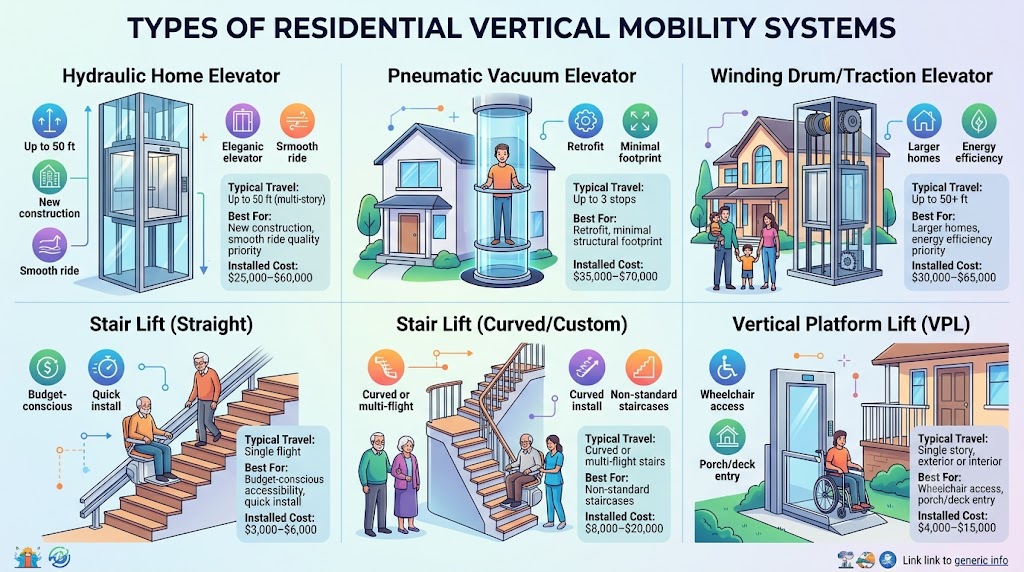
| System Type | Typical Travel | Best For | Installed Cost |
|---|---|---|---|
| Hydraulic Home Elevator | Up to 50 ft (multi-story) | New construction, smooth ride quality priority | $25,000–$60,000 |
| Pneumatic Vacuum Elevator | Up to 3 stops | Retrofit, minimal structural footprint | $35,000–$70,000 |
| Winding Drum/Traction Elevator | Up to 50+ ft | Larger homes, energy efficiency priority | $30,000–$65,000 |
| Stair Lift (Straight) | Single flight | Budget-conscious accessibility, quick install | $3,000–$6,000 |
| Stair Lift (Curved/Custom) | Curved or multi-flight stairs | Non-standard staircases | $8,000–$20,000 |
| Vertical Platform Lift (VPL) | Single story, exterior or interior | Wheelchair access, porch/deck entry | $4,000–$15,000 |
New Construction vs. Retrofit Installation
Incorporating an elevator shaft into new construction or a major addition is significantly more cost-effective than retrofitting an existing multi-story home, since the structural shaft, electrical rough-in, and pit or overhead clearance can be designed into the original framing plans. Retrofit installations, particularly pneumatic vacuum elevators, have grown in popularity specifically because they require minimal structural modification — no hydraulic pit or full shaft construction — making them a practical option for homeowners adding accessibility to an existing home without major renovation.
Key Factors Affecting Cost
- Number of stops/floors: Each additional floor increases shaft, rail, and control system cost.
- Cab size and finish level: Custom cab interiors with premium materials (glass, hardwood, designer lighting) significantly increase cost beyond standard finish packages.
- Structural modification requirements: Retrofit projects requiring new shaft construction, floor openings, or structural reinforcement add substantial labor cost.
- Drive system: Hydraulic systems are generally less expensive than traction or pneumatic systems but require a small machine room; traction and pneumatic systems eliminate this requirement at a cost premium.
- Permitting and code compliance: Home elevators are subject to ASME A17.1 safety code requirements and typically require both building and elevator-specific permits.
Safety Standards and Code Compliance
Unlike many home improvement categories, residential elevators are governed by a specific national safety standard — ASME A17.1, Section 5.3, which covers private residence elevators. This standard mandates safety features including emergency braking systems, battery backup lowering (allowing the cab to safely descend to the nearest floor during a power outage), and door interlock systems. Homeowners should confirm any installer and equipment they’re considering is fully compliant with current ASME A17.1 requirements and that the local jurisdiction’s elevator inspection requirements are being met, as this is a life-safety system, not a standard construction project.
Accessibility and Aging-in-Place Planning
For homeowners planning to age in place, incorporating vertical mobility solutions before they become urgently necessary allows for better design integration and often lower cost than an emergency retrofit later. Many aging-in-place design consultants recommend evaluating elevator shaft “stacking” — designing closet or storage space on each floor that could later be converted to an elevator shaft — even when immediate installation isn’t planned, preserving the option for lower-cost future installation.
How to Choose an Elevator Installer
- Is the company a certified installer for a recognized residential elevator manufacturer, with documented ASME A17.1 compliance?
- Do they hold an elevator contractor license, which is separate from general contractor licensing in most states?
- What is included in their maintenance contract, and how frequently is service recommended (typically annual, at minimum)?
- Do they coordinate directly with the local elevator inspection authority for required permits and inspections?
- What is the warranty period on the drive system, cab, and controls, and is emergency service available?
Ongoing Maintenance Requirements
Residential elevators require professional maintenance, typically on an annual or semi-annual basis, including inspection of safety brakes, door interlocks, cables or hydraulic fluid, and control systems. Annual maintenance contracts typically range from $300–$800, and neglecting scheduled maintenance can both compromise safety and void manufacturer warranties. Many jurisdictions also require periodic third-party safety inspections, similar to commercial elevator requirements, though specific rules vary by state.
Common Mistakes Homeowners Make When Planning a Home Elevator
A frequent mistake in new construction and major renovation projects is failing to plan for elevator shaft space early in the design process, resulting in either an awkward, costly retrofit later or the permanent loss of the option entirely once floor plans are finalized. Homeowners considering aging-in-place planning sometimes wait until mobility needs become urgent before investigating elevator options, which limits available time for thoughtful design and may force a rushed decision under less favorable circumstances than proactive planning would allow. Another common error is underestimating the importance of choosing a contractor with specific elevator contractor licensing, assuming a general contractor familiar with the rest of a renovation project can also appropriately manage the elevator installation; the specialized safety code requirements involved make this a genuinely distinct trade requiring its own licensed expertise. Finally, homeowners occasionally overlook ongoing maintenance costs when budgeting for an elevator, treating it as a one-time expense rather than a system requiring the sustained annual maintenance investment necessary to remain safe and functional over its service life.
Comparing Total Cost of Ownership Across System Types
While upfront installation cost is the most visible comparison point between elevator system types, total cost of ownership over a 15-20 year period should also factor in maintenance requirements and expected component longevity. Hydraulic systems generally have lower upfront cost but require periodic hydraulic fluid service and machine room space; pneumatic vacuum systems have higher upfront cost but a simpler mechanical design with fewer serviceable components, which some homeowners find results in lower long-term maintenance costs despite the higher initial investment. Traction systems, while historically associated primarily with commercial buildings, have become more accessible for residential use and offer strong energy efficiency, an increasingly relevant consideration as homeowners weigh long-term operating costs alongside upfront pricing.
Universal Design and Broader Accessibility Planning
A home elevator is often one component of a broader universal design or aging-in-place strategy, which may also include zero-step entries, wider doorways and hallways, curbless showers, and lever-style door hardware. Homeowners planning significant accessibility investments may benefit from consulting a Certified Aging-in-Place Specialist (CAPS), a credential offered through the National Association of Home Builders, who can provide a comprehensive assessment of a home’s accessibility needs beyond vertical mobility alone, helping ensure the elevator investment is integrated into a cohesive overall accessibility plan rather than addressed in isolation.
Reading an Elevator Proposal Like a Professional
A trustworthy home elevator proposal should specify the exact drive system type, cab dimensions, weight capacity, and number of stops, along with confirmation of ASME A17.1 Section 5.3 compliance, rather than a general reference to “residential elevator.” Confirm the proposal itemizes structural modification work separately from the elevator equipment and installation itself, since retrofit projects often involve significant carpentry, electrical, and sometimes structural engineering work beyond the elevator manufacturer’s own scope. Request documentation of the specific safety features included — battery backup lowering, door interlocks, emergency communication — and confirm which ongoing maintenance and inspection services are included in the first year versus billed separately afterward. Finally, verify the proposal clearly states who is responsible for coordinating the required elevator-specific permit and inspection process with your local jurisdiction, since this varies by installer and is an easy detail to overlook until it causes a project delay.
Making the Final Decision: Planning Ahead Pays Off
Whether motivated by luxury design goals, accessibility needs, or proactive aging-in-place planning, home elevator decisions generally benefit most from early planning rather than reactive decision-making. Homeowners who incorporate shaft space into new construction or major renovation plans, even if full installation is deferred to a later date, preserve significantly more flexibility and cost efficiency than those who must retrofit a finished home under time pressure. If immediate installation isn’t in the budget, discussing “elevator-ready” design provisions with your architect or builder is a worthwhile conversation that can meaningfully reduce future installation cost and complexity.
Coordinating Elevator Installation With Broader Renovation Plans
For homeowners undertaking a significant renovation for other reasons, evaluating elevator or accessibility lift installation as part of the same project generally results in meaningfully lower incremental cost than a fully standalone project undertaken later, since shared demolition, structural, and finish work can be coordinated across both scopes simultaneously. Discussing this possibility with your general contractor and elevator installer together, even if the elevator installation is ultimately deferred, helps ensure current renovation decisions don’t inadvertently complicate a future installation. Even a modest investment in preserving shaft-compatible floor plan alignment across levels during an otherwise unrelated renovation can meaningfully reduce the cost and complexity of a future elevator retrofit, making it a worthwhile discussion even for homeowners who aren’t yet ready to commit to full elevator installation.
Key Terms Glossary
- ASME A17.1: The national safety code governing elevators, including Section 5.3, which specifically covers private residence elevators.
- Battery Backup Lowering: A required safety feature allowing an elevator cab to safely descend to the nearest floor and open its doors during a power outage.
- Pneumatic Vacuum Elevator: An elevator system using air pressure differential to move the cab, requiring minimal structural footprint and no separate machine room.
- Certified Aging-in-Place Specialist (CAPS): A credential offered through the National Association of Home Builders for professionals specializing in accessible home design.
Frequently Asked Questions
Do home elevators require a machine room like commercial elevators?
Hydraulic systems typically require a small machine room (roughly the size of a closet), while pneumatic vacuum and some traction systems eliminate this requirement, which is a key consideration for retrofit projects with limited space. Homeowners with especially tight floor plans should discuss this constraint early with prospective installers, since it often narrows the realistic system options before other factors like budget and finish preferences are even considered, making an early space assessment one of the most valuable first steps in the planning process.
How much space does a home elevator shaft require?
Typical residential elevator shafts require approximately 15–20 square feet of floor space per level, though this varies by cab size and system type; pneumatic systems require somewhat less footprint.
Are home elevators safe during a power outage?
Yes, ASME A17.1-compliant residential elevators are required to include battery backup lowering systems that automatically bring the cab to the nearest floor and allow safe exit during a power failure.
How long does elevator installation take?
New construction installations are typically completed alongside the broader construction timeline; standalone retrofit installations generally take 2–6 weeks depending on system type and structural modification needs.
Do home elevators increase resale value?
In multi-story luxury homes and properties marketed toward aging-in-place buyers, a well-maintained, code-compliant elevator is generally viewed as a valuable feature, particularly in competitive markets with older buyer demographics.
What is the difference between a stair lift and a vertical platform lift?
A stair lift carries a seated (or in some models, standing) passenger along an existing staircase, while a vertical platform lift moves a wheelchair or passenger vertically between two levels via a dedicated platform, typically used where a full elevator isn’t feasible but wheelchair-accessible vertical movement is needed, such as a porch or deck entry.
Can a home elevator be installed in a home with limited existing floor space?
Pneumatic vacuum elevators are often the preferred solution for space-constrained retrofits, since they require a smaller footprint and no separate machine room compared to hydraulic or traction systems, though a qualified installer should always assess the specific home to confirm the best-fit solution.
Get a Custom Elevator Consultation
Because vertical mobility systems involve significant structural, electrical, and safety code considerations, a detailed on-site consultation from a certified residential elevator company is the appropriate first step. Request proposals from multiple certified installers to compare system types, cab finishes, and long-term maintenance costs. This article may contain affiliate links to vetted elevator contractor-matching services; we may earn a commission if you request a quote through these links, at no additional cost to you.
Advertisement