
Why Professional Water Damage Restoration Matters
Water intrusion — whether from a burst pipe, roof leak, appliance failure, or flooding — is one of the most time-sensitive property emergencies a homeowner can face. Mold growth can begin within 24 to 48 hours of water exposure, and structural materials like drywall, subfloor, and insulation can suffer permanent damage if moisture isn’t fully extracted and the affected area properly dried. Professional water damage restoration companies use industrial-grade equipment and moisture-tracking technology that goes far beyond what a homeowner can achieve with fans and a wet/dry vacuum, making rapid professional response critical to minimizing both damage and cost.
Advertisement
The Water Damage Restoration Process
- Emergency response and assessment: Reputable companies offer 24/7 response, typically arriving within 1–4 hours to begin mitigation before damage spreads further.
- Water categorization and classification: Technicians classify water damage by category (clean, gray, or black water) and class (extent of saturation), which determines the required protocol.
- Water extraction: Industrial pumps and truck-mounted extraction units remove standing water rapidly.
- Structural drying: Commercial-grade air movers and dehumidifiers are strategically placed to dry structural materials, monitored daily with moisture meters.
- Antimicrobial treatment: Affected surfaces are treated to prevent mold growth during the drying process.
- Reconstruction: Damaged drywall, flooring, and insulation are replaced once the structure is verified fully dry.
Water Damage Categories Explained
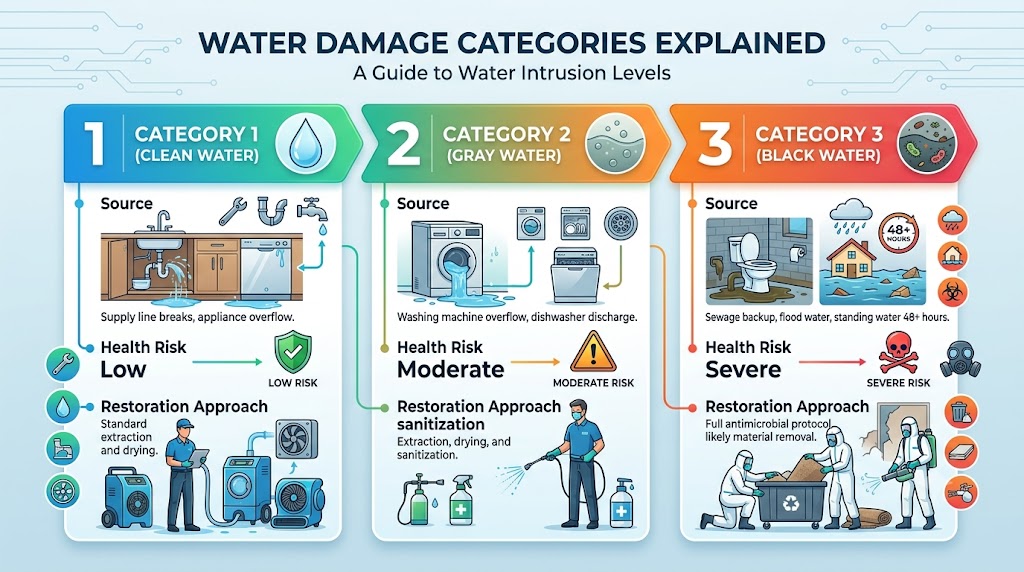
| Category | Source | Health Risk | Restoration Approach |
|---|---|---|---|
| Category 1 (Clean Water) | Supply line breaks, appliance overflow | Low | Standard extraction and drying |
| Category 2 (Gray Water) | Washing machine overflow, dishwasher discharge | Moderate | Extraction, drying, and sanitization |
| Category 3 (Black Water) | Sewage backup, flood water, standing water 48+ hours | Severe | Full antimicrobial protocol, likely material removal |
Industrial Equipment Used in Professional Restoration
- Truck-mounted water extraction units: Remove large volumes of standing water far faster than portable pumps.
- Low-grain refrigerant (LGR) dehumidifiers: Commercial-grade units that remove significantly more moisture from the air than residential dehumidifiers.
- Axial and centrifugal air movers: High-velocity fans positioned to accelerate evaporation across wet surfaces.
- Thermal imaging cameras: Detect moisture trapped behind walls and under flooring that isn’t visible to the naked eye.
- Penetrating and non-penetrating moisture meters: Used to verify materials have reached acceptable dryness standards before reconstruction begins.
Cost Breakdown by Damage Severity
- Minor water damage (single room, clean water): $1,300–$4,000
- Moderate damage (multiple rooms, gray water): $4,000–$12,000
- Severe damage (whole floor, black water/sewage): $12,000–$50,000+
- Structural drying equipment rental alone (if self-managed): $150–$400 per day per unit, typically requiring multiple units for several days
Costs vary based on square footage affected, water category, how long the water was present before mitigation began, and whether structural materials require full replacement versus drying in place.
Insurance Claims and Documentation
Water damage claims are among the most common homeowners insurance claims, but coverage details vary significantly by policy and cause of loss — sudden pipe bursts are typically covered, while gradual leaks or flood damage often require separate coverage. Professional restoration companies typically document damage extensively with photos, moisture readings, and detailed scope-of-work reports, which is critical for a smooth insurance claim. It’s advisable to choose a restoration company experienced in working directly with insurance adjusters and, ideally, one that offers direct insurance billing.
How to Choose a Water Damage Restoration Company
- Is the company IICRC certified (Institute of Inspection, Cleaning and Restoration Certification), the industry standard credential?
- Do they offer genuine 24/7 emergency response, and what is their average arrival time?
- Do they use moisture-mapping documentation and provide daily drying logs?
- Do they have in-house reconstruction capabilities, or will you need to hire a separate contractor for repairs?
- Do they work directly with insurance companies and provide detailed, itemized invoicing (Xactimate estimates)?
Preventing Future Water Damage
While not every water event is preventable, several investments significantly reduce risk: smart water leak detection sensors with automatic shutoff valves, regular inspection of supply lines and appliance hoses, sump pump battery backup systems, and proper grading and gutter maintenance to direct water away from the foundation. Many of these preventive systems also qualify for homeowners insurance premium discounts, making them a worthwhile investment beyond the direct risk reduction.
Common Mistakes Homeowners Make During a Water Damage Event
The most damaging mistake is delaying professional response while attempting to manage significant water intrusion with household fans and towels; given that mold growth can begin within 24-48 hours, every hour of delay increases both the eventual restoration cost and the risk of secondary damage such as mold contamination or structural deterioration. Homeowners should also avoid discarding damaged items before documenting them with photos, since this documentation is typically required for insurance claims and its absence can complicate or delay claim processing. Another common error is assuming a space is fully dry based on visual appearance alone; carpet, drywall, and subfloor can appear dry to the touch while retaining significant trapped moisture, which is why professional moisture meter verification is an essential step that shouldn’t be skipped even when a homeowner feels confident the area looks dry. Finally, hiring the first available contractor without confirming IICRC certification or requesting a detailed scope of work can result in incomplete drying, particularly in hidden areas like wall cavities, leading to mold issues that surface weeks or months later.
Regional Water Damage Risk Factors
Water damage risk profiles vary considerably by region. Homes in the Sun Belt and Gulf Coast face elevated risk from both hurricane-related flooding and the region’s high humidity, which can slow natural drying and increase mold risk following any water intrusion event. Northern and Midwestern homes face particular risk from frozen and burst pipes during winter cold snaps, as well as ice dam-related roof leaks that can introduce water into attic and wall spaces gradually over an entire winter season before becoming visible. Older homes throughout the country, regardless of region, face elevated risk from aging plumbing systems, particularly polybutylene pipe installed in many homes built between the 1970s and 1990s, which is known for a higher failure rate than modern PEX or copper plumbing. Understanding your property’s specific regional and structural risk factors can help prioritize preventive investments like leak detection sensors and, where relevant, pipe replacement planning.
The Role of Moisture Mapping in Ensuring Complete Restoration
Professional restoration companies use systematic moisture mapping — documenting moisture readings at multiple points throughout the affected area at the start of the project and at regular intervals throughout the drying process — to verify that materials have reached industry-standard dryness benchmarks before reconstruction begins. This documentation protects homeowners by providing objective evidence that the space was fully dried, rather than relying on a visual or subjective assessment, and it becomes an important record if any dispute arises later regarding the completeness of the restoration work. Homeowners should request a copy of this moisture-mapping documentation as part of their project file, both for their own records and in case a future issue requires reference back to the original drying verification data.
Reading a Restoration Invoice Like a Professional
Professional water damage restoration invoicing typically follows the Xactimate estimating system widely used across the insurance industry, which itemizes charges by specific line items — equipment rental per day, labor hours, material disposal, and antimicrobial treatment — rather than a single lump-sum charge. Familiarity with this format helps homeowners and insurance adjusters evaluate whether pricing aligns with regional industry standards. Request daily drying logs showing moisture readings at multiple monitored points throughout the affected area, since this documentation demonstrates the drying process was properly verified rather than assumed complete based on a visual check. If reconstruction is included in the same contract, confirm whether it’s priced separately from the mitigation work, since some restoration companies subcontract reconstruction while others handle it in-house, which can affect both pricing and project timeline coordination.
Making the Final Decision Under Time Pressure
Water damage emergencies rarely allow for the leisurely, multi-week research and comparison process appropriate for many other home improvement decisions, which makes advance preparation particularly valuable. Homeowners are well served by identifying and saving contact information for one or two IICRC-certified restoration companies before an emergency occurs, rather than searching under pressure during an active water event. Even in an emergency, it’s reasonable to ask a responding company for their IICRC certification number and to confirm they’ll provide detailed documentation throughout the process, since a reputable company will readily provide this information even when responding urgently, and companies unwilling to do so may warrant additional scrutiny despite the time pressure of the situation.
Coordinating With Your Insurance Adjuster
When a water damage claim is involved, choosing a restoration company experienced in working directly with insurance adjusters can significantly smooth the claims process. These companies typically understand what documentation adjusters require, can communicate in the standardized terminology adjusters expect, and in many cases can bill the insurance company directly, reducing the homeowner’s out-of-pocket burden during an already stressful situation. It’s reasonable to ask a prospective restoration company about their specific experience working with your insurance carrier before selecting them for the project.
Key Terms Glossary
- IICRC: The Institute of Inspection, Cleaning and Restoration Certification, the primary industry credentialing body for water damage and mold remediation professionals.
- Category 1/2/3 Water: A classification system describing the contamination level of water damage, ranging from clean supply-line water (Category 1) to sewage or flood water (Category 3).
- LGR Dehumidifier: A low-grain refrigerant dehumidifier, a commercial-grade unit capable of removing significantly more moisture from the air than standard residential dehumidifiers.
- Moisture Mapping: The systematic documentation of moisture readings at multiple points throughout an affected area to track and verify the drying process.
- Xactimate: A widely used estimating software in the insurance and restoration industry, generating itemized, standardized project cost estimates.
Frequently Asked Questions
How quickly does mold start growing after water damage?
Mold growth can begin within 24 to 48 hours in favorable conditions, which is why rapid professional response is critical to minimizing both structural damage and mold remediation costs.
Will homeowners insurance cover water damage restoration?
This depends on the cause. Sudden, accidental water damage such as a burst pipe is typically covered, while damage from long-term neglect, gradual leaks, or flooding usually is not covered under a standard policy and may require separate flood insurance.
Can I dry out water damage myself with fans and a dehumidifier?
For very minor, immediately addressed spills, yes. However, for any significant water intrusion, professional-grade equipment and moisture verification are typically necessary to prevent hidden moisture from causing mold growth or structural damage later.
How long does the structural drying process take?
Typically 3–5 days for standard drying, though severe cases involving saturated structural materials can take 7–10 days or longer, verified through daily moisture readings.
What is the difference between water damage restoration and mold remediation?
Water damage restoration focuses on extracting water and drying the structure to prevent mold from developing; mold remediation is a separate, more extensive process required when mold has already begun growing.
Should I call my insurance company or the restoration company first?
Most restoration companies recommend calling them first for emergency mitigation, since rapid response limits damage, and they can typically help initiate the insurance claim process on your behalf; however, check your specific policy for any required notification timeline to your carrier.
Can I stay in my home during water damage restoration?
This depends on the extent and category of damage; minor, localized water damage typically allows homeowners to remain in the home, while extensive damage, black water contamination, or work requiring removal of large sections of drywall may necessitate temporary relocation, which your restoration company can advise on based on the specific situation.
Get Connected With a 24/7 Certified Restoration Company
Because timing is critical in water damage situations, it’s important to have a plan before an emergency occurs. Research IICRC-certified restoration companies in your area in advance, and don’t hesitate to request quotes from multiple providers even during an active emergency — reputable companies understand the urgency and will respond quickly regardless. This article may contain affiliate links to vetted restoration company-matching services; we may earn a commission if you request service through these links, at no additional cost to you.
Advertisement